
Screens are an unavoidable part of modern family life, but managing screen time for kids and sleep in UAE presents a unique set of challenges. From tablets at the dinner table to YouTube clips before bed and online schoolwork starting as early as age five, digital devices are woven into the fabric of our daily routines. However, the research on how this digital immersion affects development is now substantial enough for parents to take proactive steps.
Families in UAE navigate a unique set of challenges: high academic pressure, long indoor hours driven by the intense summer heat, and widespread device availability. These factors often make screen management feel like an uphill battle. While most parents intuitively know that “too much screen time” isn’t ideal, many lack a practical, age-specific framework to define what “healthy” actually looks like in a local context. Navigating the digital landscape requires a clear understanding of healthy screen time for kids.
According to the World Health Organization (WHO), children under two should have zero sedentary screen time (with the exception of video calling), and those aged 2–5 should be limited to less than one hour per day. Despite these clear benchmarks, clinical observations at ESMC show a rising trend: sleep deprivation in school-age children is strongly linked to behavioral dysregulation, attention difficulties, and academic under-performance. Furthermore, screen use within one hour of bedtime is associated with significantly delayed sleep onset across all pediatric age groups.
In this comprehensive guide, the pediatric team at ESMC provides a clinical breakdown of screen time limits, sleep requirements, and the behavioral red flags that indicate when digital habits have crossed the line from a modern convenience to a clinical concern. Establishing these boundaries is the first step in managing screen time for kids.
Table of Contents
Why Screen Time, Sleep, and Behaviour Are Clinically Linked
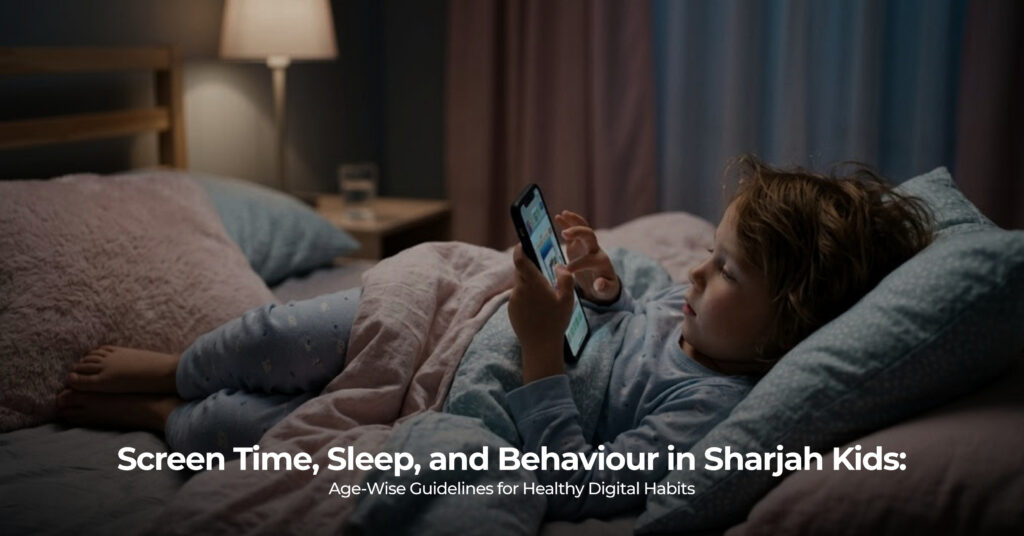
It is a common misconception to view screen time, sleep quality, and child behaviour as three separate issues. In reality, they form a physiological and psychological loop that can either support or undermine a child’s development.
The Neurological Connection
Children’s brains are not just smaller versions of adult brains; they are neuroplastic environments under constant construction. Screens stimulate dopamine pathways in the brain’s reward system far more intensely in children. This high-stimulation environment can make real-world interactions feel “boring” by comparison, leading to irritability when the device is removed.
Furthermore, the blue light emitted by smartphones and tablets suppresses the production of melatonin, the hormone responsible for sleep. Children are physically more sensitive to blue light than adults. When melatonin is suppressed, the internal clock shifts, making it harder for the child to fall asleep even after the device is turned off.
Interestingly, sleep deprivation in children rarely looks like “tiredness.” While an adult might become lethargic, a sleep-deprived child often presents with hyperactivity, impulsivity, and aggression. This “tired but wired” state is frequently misread by parents and sometimes even educators as a primary behavioral disorder rather than a symptom of poor sleep hygiene. This physiological cycle highlights the importance of monitoring screen time for kids
Why UAE’s Context Makes This Harder to Manage
Managing these habits in the UAE requires acknowledging our specific environment:
- Climate Constraints: Extreme summer heat often pushes children indoors for months at a time, leading to an increase in passive screen time as a default activity.
- Academic Rigor: High expectations from early ages often involve screen-based homework, research, and tutoring, blurring the lines between “productive” and “recreational” use.
- Household Dynamics: In many UAE homes, multi-generational living means screen norms vary between parents, grandparents, and caregivers, making consistency difficult.
- The Weekend Shift: The Thursday–Friday transition often involves late-night family gatherings and social dinners, which can disrupt sleep consistency just as the child is supposed to be recovering from the school week.
Local environmental factors often lead to an unintended increase in screen time for kids.
At ESMC, our clinical team increasingly observes that behavioral concerns referred for assessment are often rooted in sleep disruption caused by evening screen habits rather than underlying neurological disorders. Think of it this way: Sleep is the fuel, and screen time is a leak in the tank. Without addressing the leak, you cannot fix the engine. Clinicians at ESMC emphasize that sleep quality is directly impacted by excessive screen time for kids.
Age-Wise Screen Time for Kids and Sleep Guidelines
Infants and Toddlers (0–2 Years)
- Screen Time: Zero. The WHO and AAP recommend no screen time for children under 18–24 months, with the sole exception of video chatting with family.
- Sleep Needs: 12–16 hours (including naps).
- Behavioral Red Flags: Excessive irritability, difficulty self-soothing, or delayed language milestones. Research suggests that “background TV” (screens on in the room while the child plays) can negatively impact language development by reducing the quality of parent-child interaction.
| Do’s | Don’ts |
| Use video calls to connect with distant relatives. | Use background TV as ambient noise. |
| Prioritize face-to-face “serve and return” interaction. | Use screens as a primary tool to help a child fall asleep. |
| Stick to a highly consistent nap and bedtime routine. | Allow any screen presence in the child’s sleep environment. |
Pediatric guidelines recommend a strict approach to screen time for kids in this age bracket.
Preschool Age (2–5 Years)
- Screen Time: A maximum of 1 hour per day of high-quality, educational content.
- Sleep Needs: 10–13 hours (including naps).
- Behavioral Red Flags: Intense tantrums when a screen is removed that are disproportionate to the child’s age, or a declining interest in social play with peers.
| Do’s | Don’ts |
| Co-view content and discuss what is happening on screen. | Allow screens during meal times. |
| Choose interactive educational apps over passive videos. | Use screens as a reward or punishment tool. |
| Ensure all screens are off 1 hour before bedtime. | Allow unrestricted YouTube “autoplay” features. |
Educational goals should be balanced with strict limits on total screen time for kids.
Early School Age (6–9 Years)
- Screen Time: At this stage, quality and context matter more than a hard “minutes” limit, but pediatricians generally recommend keeping recreational use under 2 hours.
- Sleep Needs: 9–12 hours per night.
- Behavioral Red Flags: Avoiding homework in favor of gaming, social withdrawal, or mood changes that correlate specifically with the removal of a device.
| Do’s | Don’ts |
| Establish a clear, written “Family Media Plan.” | Allow devices in bedrooms overnight. |
| Enforce a “Device-Free Bedroom” policy. | Allow screens to replace outdoor or physical play. |
| Distinguish between “school screens” and “fun screens.” | Let screens fill all “boredom” or unstructured time. |
Creating a structured environment helps maintain a healthy balance of screen time for kids.
Preteens and Tweens (10–12 Years)
- Screen Time: Social media often enters the picture here. While limits are harder to enforce, they remain clinically vital to protect sleep and mental health.
- Sleep Needs: 9–11 hours per night. Note: Most children in this age group in UAE are significantly under sleeping due to late-night social or academic demands.
- Behavioural Red Flags: Anxiety driven by social comparison, complaints of being unable to fall asleep, secretive device use, or a total loss of interest in offline hobbies.
| Do’s | Don’ts |
| Use collaborative rule-setting to give the child agency. | Provide unrestricted, unmonitored social media access. |
| Use transparent parental controls as a safety net. | Ignore early signs of anxiety linked to online interaction. |
| Have regular, non-judgmental talks about online safety. | Allow phones to be the last thing seen before sleep. |
Open communication is vital when overseeing the social aspects of screen time for kids.
Sleep: The Non Negotiable Foundation
Sleep is not just “rest.” It is a period of intense neurological activity where the brain clears toxins, consolidates learning, and releases growth hormones. According to the Sleep Foundation’s pediatric recommendations, these sleep durations are non-negotiable for a child’s immune function and emotional regulation. In UAE’s late-night social culture, children’s bedtimes are frequently pushed later than developmental guidelines recommend, leading to chronic “social jet-lag.” Protecting the sleep cycle is the primary reason to regulate screen time for kids.
Signs Your Child Is Not Getting Enough Sleep
- Morning Struggles: Extreme difficulty waking up, even if they seem to have been in bed for 8 or 9 hours.
- Afternoon “Meltdowns”: Aggression or emotional dysregulation that peaks after school or in the late afternoon.
- Micro-Sleeps: Falling asleep in the car or during short periods of inactivity.
- Frequent Illness: Sleep deprivation suppresses the immune system; if your child catches every cold going around, check their sleep duration.
- The Weekend Crash: A significant difference in behaviour and mood between school days and weekends.
ESMC Clinical Note: Many children referred to us for ADHD assessments show significant symptom improvement simply by addressing sleep hygiene and screen habits first. A brain that isn’t rested cannot focus, regardless of underlying conditions. Many behavioral improvements begin with a reduction in late-night screen time for kids.
Behavioral Red Flags: When to See a Pediatrician
While every child has “off” days, certain patterns suggest that digital habits are impacting clinical health. You should consult a pediatrician if you notice:
- Escalating Aggression: Meltdowns over devices that involve physical aggression or property damage.
- Inability to Play: A child who cannot engage in any unstructured, non-digital play for more than 10 minutes.
- Persistent Sleep Issues: Difficulty falling or staying asleep that lasts more than 4 weeks despite a good routine.
- Physical Ailments: Frequent headaches, eye strain, or neck and back pain associated with device posture.
- Developmental Regression: Any loss of previously mastered skills (speech, toileting, or social cues) in a child with high screen exposure.
Persistent behavioral issues may be exacerbated by unmanaged screen time for kids.
When It May Be More Than Just Screens
It is important to clarify that while screens and poor sleep can mimic conditions like ADHD, anxiety, or Autism Spectrum Disorder (ASD), they can also coexist with them. A proper pediatric assessment is essential to distinguish between a “digital habit” issue and a developmental disorder.
At ESMC, our approach includes a full developmental history, a detailed sleep assessment, and a review of digital habits before moving toward any formal diagnosis or referral pathway. Consistency across the week is the most effective way to manage screen time for kids.
Practical Tips for UAE Homes
- The 60-Minute Rule: All screens off 60 minutes before the target sleep time. No exceptions.
- The “Charging Station”: Create a central location in the house (like the kitchen or hallway) where all devices “sleep” overnight. This ensures bedrooms remain a sanctuary for rest.
- Replace, Don’t Just Remove: If you take away the tablet, replace the wind-down time with a bath, a physical book, or a calm conversation.
- Model the Behavior: Children mirror their parents. If you are on your phone during dinner, they will struggle to understand why they cannot be on theirs.
- Intentional Weekends: Use Thursday nights carefully. Allowing a “screen marathon” on Thursday can disrupt the entire weekend’s rhythm and make Sunday morning much harder for the child to maintain healthy screen time for kids.
Frequently Asked Questions
Q: My toddler only watches educational content. Does the 1-hour limit still apply?
A: Yes. Even if the content is educational, the physiological impact (blue light, dopamine stimulation, and sedentary behaviour) remains the same. Balance is key. The one-hour limit is a crucial benchmark for screen time for kids.
Q: How do I know if my child’s behaviour is from screens or something else?
A: Try a “digital detox” for 7–10 days with a strict focus on sleep hygiene. If the behaviour improves significantly, digital habits were likely a major factor. If it persists, a professional assessment is needed. A digital detox is an effective way to assess the impact of screen time for kids.
Q: My child says they can’t sleep without a screen. How do I break this?
A: This is a habit, not a physiological need. Transition to audio books or white noise machines, which provide the “noise” they crave without the harmful blue light. Breaking the habit of using devices at night is essential for healthy screen time for kids.
Q: When should I see a pediatrician?
A: If screen habits are causing daily conflict, if sleep is consistently disrupted, or if you see any of the “red flags” mentioned above, it’s time for a professional review.Professional guidance can help resolve conflicts surrounding screen time for kids.
Conclusion
The goal of healthy screen time for kids is not to eliminate technology, it is to ensure that screens are not making the primary decisions for your family’s health. In UAE, where the environment and social culture present unique challenges, being intentional about digital boundaries is an act of essential parenting.
Sleep is the non-negotiable foundation of your child’s growth. When sleep is protected and screens are managed with age-wise awareness, many behavioral “problems” often resolve themselves. Prioritizing sleep starts with being intentional about screen time for kids.
If you are concerned about your child’s digital habits, sleep quality, or behaviour, the ESMC pediatric team is here to help. We provide comprehensive developmental assessments, sleep guidance, and personalized media plans tailored to the needs of UAE families. Contact our experts today to develop a customized plan for managing screen time for kids.
Prioritize Your Child’s Healthy Development
Don’t let screen habits impact your child’s sleep and behavior. Book a pediatric consultation at ESMC for a personalized developmental assessment and media plan.