Vaginal tightening in UAE is something many women research privately, late at night, without ever saying a word to their doctor. You have not said anything to your husband. You have not mentioned it at your last check-up. You have just been quietly noticing that something has fundamentally changed since your second delivery. Maybe it is a persistent physical discomfort during daily movement. Maybe it is a noticeable reduction in sensation during intimacy. Perhaps it is the small, frustrating leaks of urine when you cough, sneeze, or laugh that you have silently learned to manage around. You have likely Googled these changes once or twice, felt a wave of uncertainty, and quickly closed the tab.
These physical changes are extremely common, medically recognized, and absolutely legitimate to address. A large proportion of women experience them after vaginal delivery or during menopause. You do not need to travel to Dubai or abroad for advanced care. Safe, highly effective solutions are available at Erum Saba Medical Center in Sharjah, with an all-female gynecology team in a completely private clinical environment. ESMC offers a specialized approach to vaginal tightening for women seeking restored comfort and function.
Table of Contents
Understanding Vaginal Laxity: Why These Changes Happen
The vaginal canal and its opening are supported by a layered network of pelvic floor muscles, connective tissue, and collagen fibres. During a vaginal delivery, these deep structural tissues must stretch significantly to allow the passage of the baby. According to the Royal College of Obstetricians and Gynaecologists (RCOG), perineal tears occur as the baby stretches the vagina and perineum during birth, and when a labour is prolonged or a baby is large, these supportive fibres can overstretch or tear. The American Journal of Obstetrics and Gynecology notes that perineal trauma affects 50 to 90 percent of women after vaginal childbirth, making it one of the most common yet under-discussed areas of women’s health.
As women age, a separate process occurs. The natural decline in oestrogen levels during perimenopause and menopause causes a systemic loss of collagen throughout the body, directly impacting pelvic tissues. According to PMC research on Genitourinary Syndrome of Menopause (GSM), this hypoestrogenic state results in thinning, drying, and reduced elasticity of vaginal mucosal tissue, alongside loss of structural support and tone.
This is not a superficial cosmetic concern. Vaginal laxity carries distinct functional consequences: stress urinary incontinence, vaginal dryness, physical discomfort during daily movement, and a marked reduction in sensation. Many women across the UAE carry these concerns silently for years, falsely believing they are an inevitable consequence of having children or growing older. They are not. Clinical interventions exist to address them effectively and safely. Understanding the underlying causes is the first step toward effective vaginal tightening.
Two Distinct Solutions: CO2 Laser vs Perineorrhaphy
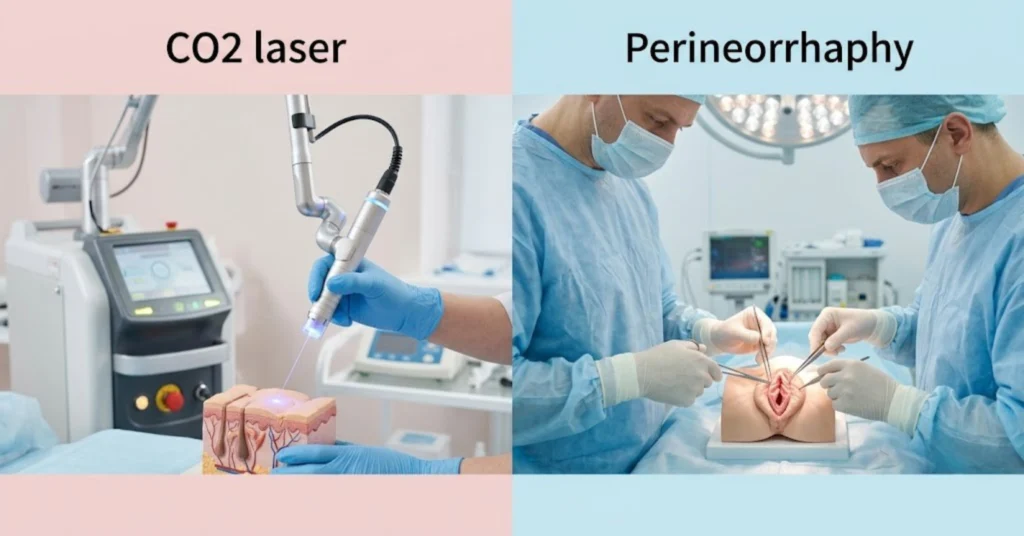
When exploring options for vaginal tightening in UAE, the two main clinical approaches address entirely different anatomical structures and different degrees of tissue change. Understanding the distinction between them is essential before any decision is made.
CO2 Fractional Laser (Non-Surgical)
The fractional carbon dioxide laser is a non-surgical, outpatient treatment designed to rejuvenate the internal lining of the vaginal canal. The device delivers controlled, precise thermal energy into the superficial layers of the vaginal mucosa. According to a peer-reviewed study published in PMC on fractional CO2 laser for vaginal laxity, this thermal energy stimulates fibroblasts to produce new collagen and elastin fibres, resulting in measurable increases in vaginal wall thickness and tissue tightness over a 10 to 12 month post-treatment period.
Further PMC research on CO2 laser and vaginal atrophy confirms that histopathological studies support CO2 laser therapy inducing collagen contraction with effects persisting for at least six months, and that 2 to 3 sessions produce consistent results in postmenopausal women with GSM symptoms.
This non-surgical approach is highly effective for women experiencing mild to moderate internal laxity, post-menopausal dryness, or mild urinary leaking. However, laser energy cannot fix major structural muscle separations or significant perineal damage. If the primary concern is structural, laser therapy will provide tissue rejuvenation but cannot physically reconnect separated muscle fibers. Laser technology offers a minimally invasive route for vaginal tightening.
Perineorrhaphy (Surgical)
Perineorrhaphy is a precise surgical procedure designed to reconstruct and strengthen the perineum: the muscular area between the vaginal opening and the anus. According to the RCOG’s clinical guidance on perineal tears and episiotomies, this specific region is frequently stretched, torn, or cut via episiotomy during childbirth, and when the muscles fail to heal back into their original alignment, the vaginal entrance can remain structurally widened and unsupported.
During a perineorrhaphy, the gynecologist removes excess, stretched scar tissue. The underlying separated perineal muscles are then re-approximated and secured with absorb-able sutures, physically reconstructing the structural foundation of the lower third of the vaginal canal. This surgical approach is ideal for women with moderate to severe perineal damage, visible gaping at the vaginal opening, or structural symptoms that have not improved with pelvic floor physiotherapy. Surgical intervention remains a gold standard for structural vaginal tightening.
Because these two procedures address separate anatomical areas, they are not competing choices. Many women seeking vaginal tightening in UAE benefit most from an integrated approach combining internal laser therapy with external perineorrhaphy. This is carefully assessed during a consultation with Dr. Erum Saba. The choice between these treatments depends on individual goals for vaginal tightening.
Side by Side: CO2 Laser vs Perineorrhaphy
| CO2 Fractional Laser | Perineorrhaphy | |
|---|---|---|
| Procedure Type | Non-surgical, thermal treatment | Minor surgical procedure |
| Primary Treatment Area | Internal vaginal canal walls | Perineal body and vaginal entrance |
| Anaesthesia | None or optional topical cream | Local or regional anaesthesia |
| Sessions Needed | 1 to 3 sessions | Single procedure |
| Recovery Downtime | Minimal, 2 to 3 days of pelvic rest | 2 to 4 weeks for full healing |
| Best Suited For | Mild laxity, dryness, menopause changes | Moderate to severe structural muscle tears |
| Results Timeline | Gradual improvement over 3 to 6 months | Immediate structural correction after healing |
| Can Be Combined | Yes, frequently paired with perineorrhaphy | Yes, frequently paired with CO2 laser |
Who Is a Candidate for Vaginal Tightening?
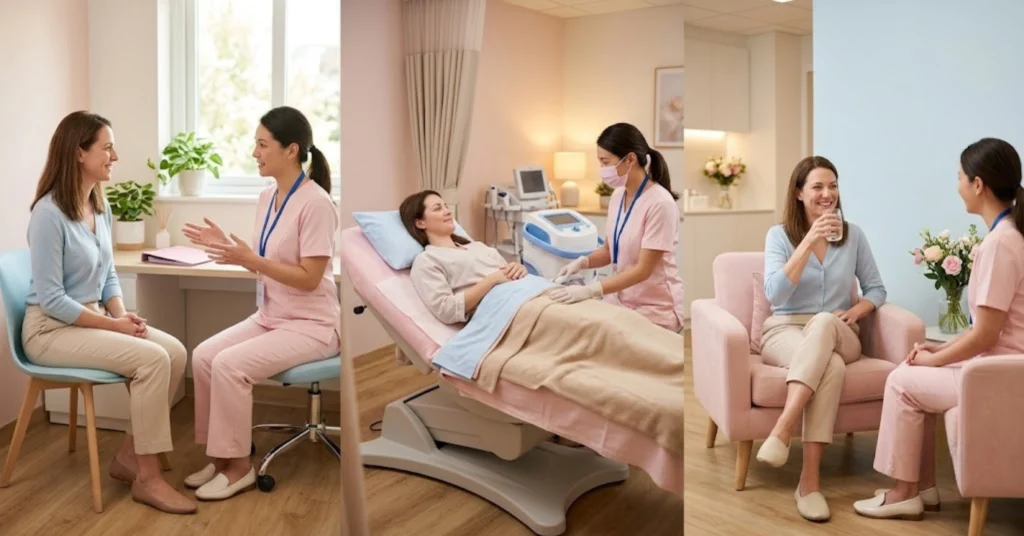
Identifying which treatment aligns with your specific situation requires a clear understanding of your medical history, anatomical structure, and future family planning goals for vaginal tightening.
CO2 Laser is well suited for: Women experiencing mild to moderate internal laxity after one or more vaginal deliveries. Post-menopausal women dealing with genitourinary syndrome of menopause, characterised by thin, dry, or easily irritated mucosal walls. Women with mild stress urinary incontinence during exercise, coughing, or laughing. Women who want improvement without surgical incisions, downtime, or general anaesthesia. Women who plan to have more children, as laser therapy does not compromise the tissue’s ability to stretch during subsequent births.
Perineorrhaphy is well suited for: Women who have completed their childbearing, as future vaginal deliveries can re-stretch surgically repaired tissue. Women with anatomically visible widening or a gaping sensation at the vaginal opening. Women who suffered significant perineal tears or episiotomies that healed poorly. Women whose structural symptoms have not improved after dedicated pelvic floor physiotherapy.
Neither procedure is appropriate for: Women who are currently pregnant or in the immediate postpartum healing phase. Women with active vaginal, pelvic, or cervical infections. Women with severe pelvic organ prolapse, who require a different category of reconstructive surgery. The only definitive way to clarify your needs is a private medical assessment. A clinical consultation is required to confirm your eligibility for vaginal tightening.
Book a Private Consultation at ESMC’s Gynaecology Department
What to Expect: The Patient Journey at ESMC
The CO2 Laser Experience
Your appointment lasts approximately 30 to 45 minutes. You lie comfortably on a standard examination table, exactly as you would for a routine cervical screening. Most patients require no anaesthesia at all, though a topical numbing cream can be applied to the vaginal opening beforehand if preferred.
A sterilised slender glass probe is gently inserted into the vaginal canal. The laser delivers brief pulses of energy in a controlled rotational pattern as the probe is guided along the canal. You will feel a mild sensation of internal warmth or light pressure. The procedure is not painful for the vast majority of patients.
You can drive yourself home or return to work the same day. Mild watery discharge for 2 to 3 days is normal as the internal lining begins its renewal process. Avoid sexual intercourse, swimming, and tampons for 3 to 5 days. For optimal results, a standard protocol consists of 1 to 3 sessions spaced 4 to 6 weeks apart, with an annual maintenance session recommended to sustain results. Consistency is key to maintaining the benefits of non-surgical vaginal tightening.
The Perineorrhaphy Experience
Perineorrhaphy is performed as a day-case procedure at ESMC, taking 45 to 60 minutes. The procedure is carried out under local anaesthesia combined with sedation, or regional anaesthesia, ensuring you remain entirely pain-free throughout.
The surgeon makes an incision along the existing scar line, separates the skin from the weakened perineal muscles, and brings the separated muscle edges together. All tissue layers are closed using fully absorbable sutures that dissolve naturally. No stitch removal is required.
You will rest in the ESMC recovery area for a few hours before discharge. Some localized swelling and a dull ache in the first week are normal and managed with standard pain relief. Take 3 to 5 days of rest from work. Avoid heavy lifting and strenuous exercise for 4 weeks. Avoid sexual intercourse and tampon use for 6 to 8 weeks to allow deep muscle layers to heal correctly. A follow-up appointment at ESMC is scheduled for 2 weeks post-procedure as standard. Adhering to recovery protocols ensures the best results for surgical vaginal tightening.
UAE-Specific Medical Considerations

Women in Sharjah and across the UAE present with specific patterns that make the topic of vaginal tightening particularly relevant locally.
Multiple closely-spaced vaginal deliveries. Many women in our community have had three or more vaginal deliveries, sometimes with short intervals between pregnancies or with larger babies. These specific childbearing patterns place cumulative stress on the pelvic floor muscles that exceeds international averages, leading to higher rates of structural perineal laxity than many women are aware of.
Cultural privacy around intimate health. The RCOG notes that many women are reluctant to discuss perineal and pelvic concerns with healthcare providers. This reluctance is amplified in culturally conservative communities. The all-female clinical team at ESMC and the entirely private consultation environment were specifically designed so that women in UAE can discuss these concerns without hesitation, in their own language, with a clinician who understands their community.
Heat and dehydration affecting vaginal atrophy. The extreme summer heat and constant indoor air conditioning in the UAE can contribute to systemic dehydration. For post-menopausal women, chronic dehydration worsens vaginal atrophy, making mucosal tissues drier and more fragile than typically seen in cooler climates. This makes professional intervention more impactful than over-the-counter moisturisers alone for this group.
No need to travel. Many Sharjah women travel to Dubai or abroad for gynecological aesthetic procedures, unaware that the same clinical standards and procedures are available locally. Both CO2 laser and perineorrhaphy are performed at ESMC Sharjah by a specialist gynecologist with international qualifications including MRCOG II (UK) and FCPS (Pakistan). UAE residents can access world-class standards for vaginal tightening locally.
When to Book a Consultation
It can be difficult to know when an anatomical change warrants professional evaluation. Consider booking a consultation at ESMC’s Gynaecology Department if you notice any of the following:
- A persistent feeling of looseness or reduced sensation during intimacy that has not resolved on its own
- Accidental urine leaks when you laugh, sneeze, cough, jump, or carry shopping
- Chronic vaginal dryness, internal burning, or itching that has not improved with standard moisturisers
- A visible or palpable gap at the vaginal opening, or the sensation of trapped air during movement
- A previous episiotomy or tear scar that feels thin, tender, or incorrectly aligned during daily activities
- You want an objective assessment of your pelvic floor health from a qualified female gynaecologist with no commercial pressure
These are functional health concerns that directly impact your daily comfort, bladder control, and quality of life. You deserve to have them evaluated with professional care.
If you are experiencing any of the above, do not wait. Book a private gynecological consultation at ESMC Sharjah. Our all-female team is available every day from 8 AM to 11:30 PM. Professional guidance is essential when considering vaginal tightening.
Book a Consultation with Dr. Erum Saba at ESMC Sharjah
Frequently Asked Questions
Is vaginal tightening safe after a C-section delivery? Yes. Vaginal tightening procedures remain entirely appropriate for women who delivered via Cesarean section. While a C-section prevents direct perineal tearing, the pelvic floor muscles still endure up to nine months of continuous downward pressure from carrying the pregnancy. This prolonged pressure frequently stretches the supportive connective ligaments, leading to moderate internal laxity and early stress incontinence that responds very well to CO2 laser therapy. A consultation with Dr. Erum Saba will confirm which treatment is appropriate based on your specific anatomy. C-section patients frequently seek vaginal tightening for pelvic floor support.
Will CO2 laser affect my ability to get pregnant again? No. The CO2 fractional laser energy penetrates only the superficial mucosal layers to stimulate collagen production. The deeper reproductive organs including the uterus and cervix are completely untouched. As confirmed by published research on CO2 laser for vaginal laxity, the procedure does not compromise the tissue’s ability to stretch during subsequent vaginal births. Many patients use laser therapy for symptom management between pregnancies and save permanent surgical repair for when their family is complete. Future family planning is a major consideration in the timing of vaginal tightening.
How many CO2 laser sessions will I need and how far apart? The majority of patients require 2 to 3 sessions for optimal tissue remodeling and lasting results. Sessions are spaced 4 to 6 weeks apart to align with the body’s natural collagen production cycle. Research published in PMC on vaginal CO2 laser and GSM outcomes confirms that this protocol produces consistent results in both post-delivery and post-menopausal patients. After completing the primary course, a single maintenance session annually is typically recommended to sustain results against natural ageing. Standard protocols ensure the biological efficacy of vaginal tightening.
Is perineorrhaphy painful and what is the recovery actually like? Perineorrhaphy is performed under effective anesthesia so there is no pain during the procedure itself. During the first week of recovery, you will experience localized swelling, tightness, and a dull ache as the perineal muscles begin to heal. This discomfort is well managed with standard oral anti-inflammatory medication and regular ice application. Most women return to desk work within 3 to 5 days and feel substantially better by two weeks. Full healing of the deep muscle layers takes 6 to 8 weeks, during which intercourse and tampon use should be avoided. Pain management is a priority during the recovery phase of vaginal tightening.
Can CO2 laser and perineorrhaphy be combined in the same treatment plan? Yes, and this is in fact the most comprehensive approach for women with both internal laxity and structural perineal damage. The perineorrhaphy physically restores a widened or damaged entrance, while the internal CO2 laser addresses the upper canal walls and improves tissue moisture and tone. These procedures can be staged sequentially or initiated in the same clinical window depending on your baseline tissue health. Dr. Erum Saba will determine the optimal sequence during your assessment. Combined treatments offer a 360-degree approach to vaginal tightening.
How do I know if my symptoms are from vaginal laxity or something else? It is not possible to differentiate between simple tissue relaxation, a deep muscular tear, pelvic organ prolapse, or another gynecological condition based on symptoms alone. A comprehensive gynecological examination is essential to assess muscle contraction strength, evaluate the vaginal walls, and rule out underlying pelvic conditions. This is precisely what the consultation at ESMC’s Gynecology Department provides, giving you a clinical road map rather than guesswork. Clinical examinations provide the only reliable path to vaginal tightening.
Is vaginal tightening covered by UAE health insurance? In most cases, UAE health insurance providers categorise vaginal tightening as an elective aesthetic procedure and do not offer direct coverage. However, if a specialist documents that treatment is required to address a severe symptomatic childbirth tear or a clinically confirmed case of stress urinary incontinence, certain premium insurance networks may consider elements of the consultation or diagnostic workup. Always confirm your specific policy details with your insurer before proceeding with care. Insurance coverage varies for elective procedures like vaginal tightening.
How is ESMC’s CO2 laser different from what beauty clinics in UAE offer? Medical-grade fractional CO2 lasers used within an accredited medical center like ESMC operate at clinically calibrated settings with precision that non-ablative devices in beauty salons cannot replicate. More importantly, your treatment at ESMC is performed by a licensed specialist gynecologist, Dr. Erum Saba, who holds MRCOG II (UK) and FCPS qualifications and understands deep pelvic anatomy, pelvic floor dysfunction, and tissue pathology. A beauty clinic cannot screen for underlying gynecological conditions, cannot diagnose, and cannot manage complications if they arise. Medical-grade equipment is vital for the safety of vaginal tightening.
I have not had children. Can vaginal laxity still affect me? Yes. Vaginal laxity and tissue thinning can affect women who have never had a vaginal delivery or pregnancy. A genetic collagen deficiency, chronic heavy lifting, persistent coughing, or the hormonal changes of menopause can all cause pelvic tissues to lose tone over time. Post-menopausal women who have never given birth frequently present with genitourinary syndrome of menopause, characterized by internal dryness, mild incontinence, and discomfort, which responds very well to non-surgical CO2 laser therapy. A consultation will confirm what is clinically present and what treatment is appropriate. Non-delivery factors can also necessitate vaginal tightening.
What is the difference between vaginal tightening and a vaginoplasty? Perineorrhaphy specifically repairs the external perineal body and the immediate vaginal entrance. A full vaginoplasty is a more extensive surgical procedure that narrows the entire length of the internal vaginal canal by excising a wedge of tissue along the internal wall and tightening the deeper vaginal muscles throughout. For most women, a combination of targeted external perineorrhaphy and non-surgical internal CO2 laser therapy achieves excellent functional and aesthetic tightening without the greater risks and recovery associated with a full vaginoplasty. The right approach for your specific anatomy will be determined during your consultation at ESMC. Choosing between surgical and non-surgical options is part of the journey toward vaginal tightening.
The Bottom Line
Vaginal tightening in UAE is no longer something women need to research alone, manage in silence, or travel abroad to address. The physical changes of childbirth and menopause are documented, legitimate medical concerns and they have effective, safe solutions available right here.
At Erum Saba Medical Center, you will receive an honest clinical opinion based entirely on your unique anatomy, from an all-female team that understands the specific healthcare patterns and cultural context of women in UAE. No pressure, no sales pitch, just clarity on what is possible and what is right for you. ESMC remains a trusted provider for those seeking vaginal tightening.
Book a private gynaecological consultation at ESMC Sharjah. Al Zahra Street, Maysaloon. Open 8AM to 11:30PM daily.
Book Your Consultation with Dr. Erum Saba Now
This article is written for general informational purposes by the gynecology team at Erum Saba Medical Center, Sharjah. It does not replace professional medical advice. If you have concerns about your pelvic floor health, vaginal laxity, or any gynecological symptoms, please consult a qualified specialist.