
Hypertrophic or hyperpigmented patches, dark spots, and uneven skin tones are among the most common skin concerns prompting adults in the UAE to seek clinical guidance. Whether you are dealing with stubborn discoloration from previous breakouts or deep-seated facial patches, finding the right pigmentation treatment Sharjah residents rely on starts with understanding that no single therapy works universally for every patient. Consulting a qualified specialist ensures that your pigmentation treatment Sharjah plan is customized to your skin’s specific needs.
Hyperpigmentation occurs when specialized skin cells known as melanocytes produce an excess of melanin, the natural pigment that gives skin its color often triggered by UV radiation, hormonal shifts, or skin inflammation. Because discoloration stems from distinct biological pathways, effective care begins with a targeted diagnosis rather than jumping straight to the strongest or most heavily marketed in-clinic procedure.
Dermatologists typically evaluate whether your concern involves melasma, post-inflammatory hyperpigmentation (PIH), or solar lentigines (sun spots), tailoring a strategy that may encompass dedicated sun protection, prescription topicals, chemical peels, micro needling, laser therapies, or a combination plan. Understanding the underlying causes of skin discoloration helps patients choose the safest pigmentation treatment Sharjah has to offer.
Table of Contents
What Causes Facial Pigmentation? Understanding Pigmentation Treatment Sharjah Options
Skin discoloration rarely has a single root cause. Pinpointing why your skin is producing excess melanin is critical to choosing a safe pathway forward:
- Sun Exposure: Chronic ultraviolet (UV) radiation stimulates melanocytes to deposit pigment unevenly, resulting in solar lentigines (age spots or sun spots).
- Melasma & Hormonal Factors: Fluctuations in estrogen and progesterone frequently linked to pregnancy, oral contraceptives, or underlying stress can cause symmetrical, blotchy brown patches to appear on the cheeks, forehead, or upper lip. The American Academy of Dermatology (AAD) identifies sunlight, pregnancy, stress, medical conditions, and certain medications among the primary factors associated with melasma.
- Acne & Inflammation (PIH): When the skin experiences trauma, deep cystic acne, eczema, or aggressive scrubbing, the healing response can leave behind flat dark marks.
- Skin Injury or Irritation: Improperly performed aesthetic procedures, harsh chemical burns, or allergic reactions frequently trigger a surge in localized pigment production. Seeking professional medical guidance prevents complications and optimizes outcomes for pigmentation treatment Sharjah residents undergo.
Is All Pigmentation the Same?
No. Treating a hormonal condition like melasma the same way you would treat a superficial sun spot can lead to frustration or severe rebound darkening.
| Type | Common Pattern | Treatment Consideration |
| Melasma | Often symmetrical facial patches (cheeks, forehead, bridge of nose) | Requires strict trigger control + individualized topical/procedural care |
| Post-Inflammatory Hyperpigmentation (PIH) | Dark marks remaining after acne, cuts, burns, or inflammation | Treat underlying inflammation + gentle pigment-modulating therapy |
| Sun-Related Pigmentation | Localized brown or tan spots on sun-exposed areas | Dermatologist assessment + selected peeling or light/laser options |
| Other Pigmentation | Varies widely based on friction, medication, or systemic factors | Requires professional face-to-face diagnosis before initiating any regimen |
An accurate clinical diagnosis is essential prior to beginning any pigmentation treatment Sharjah dermatologists recommend.
Why Should a Dermatologist Diagnose Pigmentation Before Treatment? Seeking Expert Pigmentation Treatment Sharjah
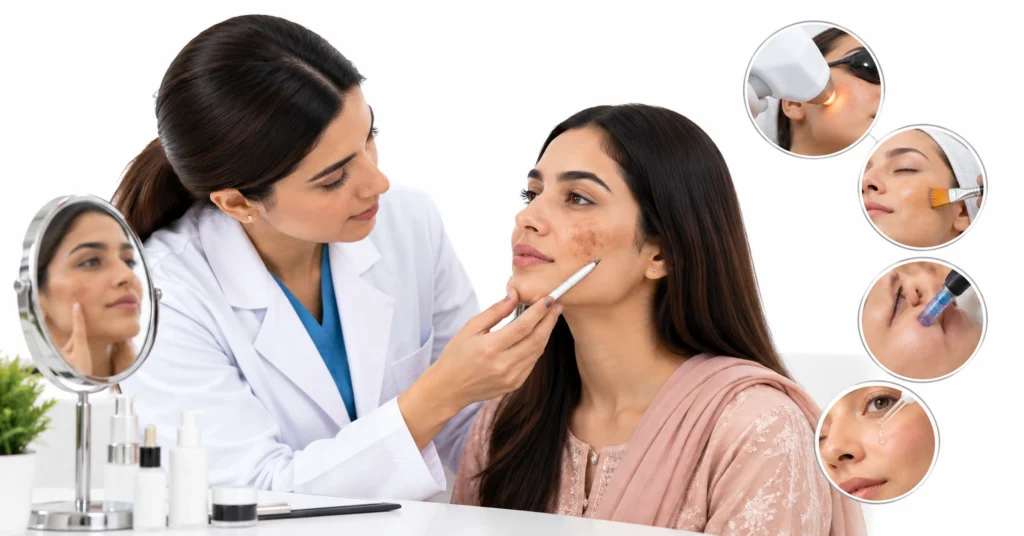
Self-diagnosing dark spots is one of the quickest ways to accidentally worsen them. Different pigmentary disorders can look strikingly similar to the untrained eye, yet sit at completely different depths within the skin layers.
- Overlapping Presentation: A dark patch that looks like a simple sun spot could actually be dermal melasma or early-stage lichen planus pigmentosus.
- Risk of Worsening: A treatment appropriate for surface-level sun damage such as an aggressive high-strength acid or deep laser can provoke severe inflammation in melasma or dark skin tones, turning mild discoloration into a darker, more stubborn shadow.
- Pigment Depth: Epidermal pigment responds differently to topicals than deep dermal pigment, which often necessitates multi-tiered medical management.
- Specialized Diagnostic Tools: A qualified dermatologist may perform a physical evaluation using specialized equipment such as a Wood’s lamp or dermatoscope to accurately map out how deep the melanin resides. Proper skin priming and barrier care are fundamental components of successful pigmentation treatment Sharjah clinical regimens.
Pigmentation Treatment Sharjah: 6 Treatment Options to Consider
When curated by a licensed specialist, your treatment plan will depend heavily on your exact diagnosis, skin type, lifestyle, and history of previous reactions. Procedures should never be selected simply because they promise a rapid fix.
1. Sun Protection and Pigment Prevention
Sun protection is not a preliminary background tip; it forms the absolute backbone of any legitimate pigmentation strategy. Without disciplined defense against both ultraviolet rays and visible light, pigment-producing cells remain reactive.
- Broad-Spectrum SPF 30+: Daily application blocks UV radiation that continuously signals melanocytes to manufacture more dark pigment.
- Consistent Application & Reapplication: Sunscreen loses efficacy over the course of the day; reapplication every two hours outdoors is mandatory.
- Visible-Light & Iron Oxides: Standard sunscreens block UV rays, but visible light (including high-energy blue/artificial light and sunlight) can heavily aggravate melasma, particularly in deeper skin tones. Dermatologists frequently recommend tinted sunscreens containing iron oxides to shield the skin from visible-light wavelengths. Combining targeted sun protection with advanced topicals maximizes the long-term success of pigmentation treatment Sharjah procedures.
Why Can Pigmentation Return After Treatment?
Melanocytes possess a “memory” and remain hyper-responsive to triggers long after a dark spot has visibly faded. Unprotected sun exposure, heat, friction, or hormonal shifts can quickly reactivate the same pathway, causing melasma or sun spots to return right where they started. Long-term maintenance and strict trigger management are essential. Consistent use of broad-spectrum sunscreen is a mandatory prerequisite for any effective pigmentation treatment Sharjah.
2. Topical Treatments for Pigmentation
Topical therapy is often the primary frontline intervention particularly for melasma used either on its own or to prep the skin prior to in-clinic procedures. Dermatologist-guided topical formulas form an essential foundation for successful pigmentation treatment Sharjah regimens.
- Hydroquinone: Long considered a gold-standard tyrosinase inhibitor that slows down excess melanin synthesis.
- Retinoids: Tretinoin or related derivatives accelerate cellular turnover, helping to shed pigmented surface cells and enhance the penetration of other active agents.
- Azelaic Acid & Brightening Agents: Ingredients like azelaic acid, kojic acid, glycolic acid, and topical vitamin C help disrupt abnormal pigment production while offering anti-inflammatory benefits.
The AAD identifies hydroquinone, tretinoin-containing regimens, and triple-combination therapy among standard treatments dermatologists utilize for melasma, alongside supportive ingredients like azelaic acid and glycolic acid for dark spots.
Why Shouldn’t You Use Strong Pigment Creams Without Medical Advice?
Reaching for high-strength or unverified “skin-whitening” concoctions carries steep hazards:
- Inflammation Triggers: Over-the-counter or rogue mixtures frequently cause contact dermatitis or chronic irritation, which paradoxically darkens the skin via PIH.
- Undeclared Steroids and Mercury: The AAD explicitly warns that many unregulated or counterfeit skin-lightening products contain hidden potent corticosteroids or toxic levels of mercury, leading to permanent skin thinning, broken capillaries, and severe systemic risks. Prescription therapies must always be monitored under direct clinical supervision. Avoiding harsh over-the-counter creams protects your skin and supports the results of pigmentation treatment Sharjah specialists prescribe.
3. Chemical Peels
Chemical peels involve applying a controlled, medical-grade acid solution to exfoliate the upper layers of the skin, lifting away damaged, melanin-dense cells to reveal fresher tissue underneath.
- Controlled Exfoliation: Depending on the acid (such as glycolic, salicylic, lactic, or specialized Jessner’s/retinoic blends), peels can target superficial epidermal discoloration.
- Customized Depth: A dermatologist adjusts the strength and duration based on your skin’s tolerance. Controlled medical exfoliation provides a gentle, proven path within comprehensive pigmentation treatment Sharjah offerings.
Are Chemical Peels Safe for Brown Skin?
They can be safe and effective, but they require extreme caution. In darker Fitzpatrick skin types, a peel that is too deep or overly aggressive will trigger heavy post-inflammatory hyperpigmentation, leaving the skin worse than before. Safe administration relies heavily on pre-peel priming, conservative acid selection, and a clinician who understands ethnic skin responses. Gentle chemical peeling helps refresh surface texture as part of a structured pigmentation treatment Sharjah plan.
4. Microneedling
Micro needling utilizes fine, sterile needles to create micro-channels in the skin. While widely known for collagen induction and scarring, it is increasingly integrated into tailored pigmentation protocols. Incorporating advanced micro-channeling can enhance active ingredient delivery during customized pigmentation treatment Sharjah procedures.
- Enhanced Product Delivery: Micro-channels allow targeted, sterile brightening serums or anti-pigment agents to penetrate deeper than topical application alone.
- Selective Application: It is never a universal first-line fix; rather, it is deployed selectively when paired with specific topical management plans under strict medical guidance.
Can Microneedling Make Pigmentation Worse?
Yes. If the needle depth is set too aggressively, or if the skin experiences excessive mechanical trauma and post-treatment inflammation, the resulting wound response can stimulate melanocytes to overproduce pigment, creating new dark spots. Technique, sterile protocols, and skin readiness are non-negotiable. Invasive procedures require careful evaluation to ensure they align with the overall pigmentation treatment Sharjah strategy.
5. Laser and Light-Based Treatments
Laser and light devices target melanin particles or blood vessels feeding pigmentary pathways, breaking down excess pigment so the body can naturally clear it away.
- Not a Universal First Choice: Lasers are precision instruments, not magic erasers. For conditions like melasma, indiscriminate or high-energy laser use can shatter pigment too violently or stimulate thermal heat that darkens the patch further.
- Settings & Device Matching: Success depends heavily on matching the exact wavelength (such as picosecond lasers, Q-switched lasers, or low-fluence laser toning) to the patient’s specific depth of pigment. Precise optical calibration is essential for maximizing therapeutic outcomes during pigmentation treatment Sharjah laser sessions.
- Qualified Supervision: These procedures must always be handled by trained, licensed dermatology specialists rather than uncertified spa operators. Laser energy must be precisely calibrated to protect delicate melanocytes during pigmentation treatment Sharjah sessions.
The AAD notes that laser or light therapies may improve melasma for selected patients typically alongside strict sun protection and topical medication while emphasizing that individualized assessment is paramount.
Is Pigmentation Laser Treatment Safe for Darker Skin?
Safety is not a simple yes-or-no answer; it depends on the specific device, the optical parameters chosen, the exact diagnosis, and the patient’s skin tone. Aggressive settings do not translate to faster clearance in darker complexions. Dermatologists frequently utilize conservative test spots, lower-fluence toning protocols, or staged treatment intervals to gauge how the melanocytes respond without provoking thermal damage. Individualized wavelength selection is vital for maintaining skin safety during laser-based pigmentation treatment Sharjah treatments.
6. Combination and Personalized Pigmentation Treatment
Rather than relying on a standalone hero procedure, modern dermatology views pigment management as an orchestrated strategy.
- Multi-Modal Synergy: A typical clinician-designed blueprint might pair daily tinted iron-oxide sunscreen with a targeted nighttime topical compound, followed by spaced-out gentle chemical peels or low-fluence laser sessions.
- Addressing Triggers First: True resolution requires suppressing the active trigger (whether hormonal, inflammatory, or UV-driven) while clearing existing pigment. A multi-modal approach yields superior, lasting results compared to single-method pigmentation treatment Sharjah options.
Why Is Combination Treatment Sometimes Different From (and Better Than) One Procedure?
Because hyperpigmentation is multi-factorial, hitting it from only one angle often results in incomplete clearance or rapid recurrence. Combining a tyrosinase inhibitor with controlled cellular turnover and physical UV/visible-light shielding interrupts the pigment-production cycle at several distinct cellular checkpoints. Multi-tiered clinical management is essential for long-term pigmentation treatment Sharjah success.
Which Pigmentation Treatment Is Best for Your Skin?
Rather than trying to force your skin into a pre-packaged spa menu, consider how dermatologists map treatment pathways to clinical presentations:
| Pigmentation Concern | Primary Treatment Approach to Discuss |
| Melasma | Broad-spectrum + tinted iron-oxide sunscreen + dermatologist-guided topical regimen ± selected low-risk procedures |
| Post-Acne Dark Marks (PIH) | Calm underlying acne/inflammation first + gentle pigment-modulating topicals ± light chemical exfoliation |
| Uneven / Sun-Related Spots | Daily UV protection + targeted topical brighteners or superficial chemical peels |
| Persistent or Recurrent Pigmentation | Full dermatologist reassessment before escalating to lasers or deeper modalities |
| Pigmentation Following an Aesthetic Procedure | Immediate evaluation to manage inflammation and halt pigment-inducing trauma |
How Long Does Pigmentation Treatment Take to Work?
Patience is a clinical requirement when treating hyperpigmentation. Pigment that took months or years to accumulate cannot be safely erased in a single afternoon.
- Realistic Timelines: The AAD notes that melasma and deep hyperpigmentation treatments commonly require anywhere from 3 to 12 months of consistent adherence to show substantial, stable improvement.
- Superficial vs. Dermal Depth: Surface sun spots may begin flaking or fading within 3 to 6 weeks of targeted topicals or peels, whereas dermal melasma demands slow, methodical dampening of cellular overactivity.
- Visible Improvement $\neq$ Cure: Seeing your skin brighten does not mean the underlying cellular tendency has vanished; maintenance protocols prevent the cycle from restarting. Understanding realistic timelines helps patients maintain consistency throughout their pigmentation treatment Sharjah journey.
Can Pigmentation Be Permanently Removed?
Not necessarily. While individual sun spots or post-acne marks can be cleared permanently if triggers are avoided, chronic conditions like melasma are managed rather than permanently cured. Hormonal shifts or sun exposure can reawaken dormant melanocytes. Effective treatment aims for long-term control, high clearance, and reliable maintenance. Long-term maintenance and daily UV defense sustain the benefits achieved through pigmentation treatment Sharjah care.
What Should You Avoid When Treating Pigmentation?
In the rush to clear dark spots, patients frequently fall into traps that aggravate the condition:
- Aggressive DIY Acids & Over-Exfoliation: Scrubbing the face raw or layering high-percentage household acids damages the skin barrier, driving severe inflammation and darker PIH.
- Unknown or “Whitening” Creams: Using unverified online tubes, street-market fairness creams, or products lacking a transparent ingredient list.
- Picking or Squeezing Active Acne: Every inflamed papule you force open dramatically increases the likelihood of leaving behind a dark post-inflammatory mark.
- Jumping Straight to High-Energy Lasers: Demanding a strong laser procedure without an initial medical diagnosis or barrier preparation.
- Skipping Sunscreen Indoors or on Cloudy Days: UVA rays penetrate window glass and cloud cover, silently driving pigment synthesis while you use active treatments. Avoiding common skincare mistakes protects the skin barrier and enhances the efficacy of pigmentation treatment Sharjah plans.
What Should You Ask a Dermatologist Before Pigmentation Treatment?
Entering a consultation armed with the right questions helps ensure transparency and safety:
- What specific type of pigmentation do I have (e.g., epidermal melasma, dermal melasma, PIH, or solar lentigines)?
- What underlying trigger is most likely driving my melanocytes to overproduce pigment?
- How deep is the pigment located, and does it require topical priming before any in-clinic procedure?
- Is a chemical peel, microneedling, or laser safe for my specific skin tone (Fitzpatrick scale)?
- What are the risks of post-inflammatory hyperpigmentation with the proposed approach?
- How many sessions or weeks should I expect before seeing measurable progress?
- What maintenance routine will keep the pigmentation from returning once it fades?
Preparing a list of questions for your consultation ensures clarity regarding your pigmentation treatment Sharjah options.
Why Consider Pigmentation Treatment at ESMC in Sharjah?
Navigating dark spots and uneven skin tones requires a clinical environment that prioritizes skin health over quick-fix promises. The Aesthetics & Laser Dermatology department at Erum Saba Medical Center (ESMC) in Sharjah approaches skin concerns through structured, individualized care:
- Customized Diagnostic Assessments: Tailored evaluation plans that analyze your skin type, pigment depth, and lifestyle triggers rather than applying a one-size-fits-all package.
- Comprehensive Treatment Pathways: Access to medical-grade topical protocols, gentle-to-moderate chemical peels, and specialized laser and skin rejuvenation services designed with pigment-prone skin in mind.
- Qualified Practitioners: Experienced dermatologic and aesthetic clinicians focused on patient safety, realistic expectations, and barrier preservation. Selecting an experienced clinical team ensures that every stage of your pigmentation treatment Sharjah is closely monitored.
Explore aesthetics and laser dermatology in Sharjah to review department capabilities, or read our broader pigmentation and melasma treatment guide for foundational context on managing discoloration safely across the UAE.
Ready to get clarity on your skin?
Book a pigmentation consultation with the clinical team at Erum Saba Medical Center in Sharjah to receive a personalized diagnosis and safe treatment roadmap. Choosing Erum Saba Medical Center guarantees compassionate, evidence-based pigmentation treatment Sharjah patients trust.
Frequently Asked Questions
What is the best pigmentation treatment?
There is no single “best” treatment because hyperpigmentation stems from different root causes. An effective approach depends entirely on whether you have melasma, post-acne marks, or sun spots, as well as your skin tone and pigment depth. Individualized care pathways help address both surface marks and deep dermal issues in pigmentation treatment Sharjah.
Can pigmentation be permanently removed?
Some forms of superficial sun-related pigmentation can be cleared and kept away with strict sun protection. However, chronic conditions like melasma tend to recur when triggered by hormones or UV/visible light, meaning treatment focuses on long-term control and maintenance.
Is a laser good for pigmentation?
Selected laser or light-based treatments can help clear specific types of stubborn pigment when performed by a qualified clinician using appropriate settings. However, lasers are not automatically the first choice and can worsen conditions like melasma if used improperly.
Is pigmentation laser safety for darker skin?
Safety depends heavily on the specific device, optical wavelength, energy settings, and the practitioner’s expertise. Darker skin tones carry a higher risk of treatment-induced hyperpigmentation, making conservative evaluations and specialized protocols essential.
What is the difference between melasma and hyperpigmentation?
Hyperpigmentation is a broad umbrella term for any area of skin that becomes darker than the surrounding tissue. Melasma is a specific, chronic acquired hyperpigmentation disorder typically appearing as symmetrical, hormone- and light-triggered patches on the face.
Does sunscreen help pigmentation?
Yes. Broad-spectrum SPF 30+ is vital, and for conditions like melasma, a tinted sunscreen containing iron oxides is especially important to block visible light, which can stimulate pigment cells just like UV rays do (American Academy of Dermatology). Daily photoprotection remains an indispensable component of long-term pigmentation treatment Sharjah maintenance.
How long does pigmentation treatment take to show results?
Visible improvement varies by treatment depth and cause. According to the AAD, melasma and persistent hyperpigmentation commonly require anywhere from 3 to 12 months of consistent adherence to a treatment plan to yield significant results.
Can acne cause pigmentation?
Yes. Post-inflammatory hyperpigmentation (PIH) frequently develops after inflammatory acne lesions, cysts, or aggressive picking heal, leaving behind flat brown, red, or dark marks.
Can chemical peels treat pigmentation?
Chemical peels can significantly improve selected types of surface pigmentation by controlled exfoliation of melanin-containing cells, provided the peel type and strength are carefully chosen by a professional to avoid irritating darker skin tones (American Academy of Dermatology).
Should I see a dermatologist for pigmentation?
Seeing a dermatologist is strongly recommended especially if your dark spots are stubborn, recurring, changing in shape, or failing to respond to basic over-the-counter skincare to ensure an accurate diagnosis before starting stronger interventions. Dermatologist-led protocols ensure that pigmentation treatment Sharjah patients receive is both safe and effective for ethnic skin tones.
Where can I get pigmentation treatment in Sharjah?
You can schedule a professional skin assessment and explore tailored treatment options with the dermatology and aesthetics team at Erum Saba Medical Center in Sharjah.