
Child sleep problems is one of the most common concerns our pediatric team at ESMC hears every May and June. It is 11:30 PM. Your child has been in bed since 9. They have been out of bed four times — for water, for the toilet, because they heard a noise, and most recently because they cannot sleep. You are lying on your side of the bedroom listening to them chat to themselves, calculating how many hours of sleep you will get if you fall asleep right now. The answer is not enough. This scenario is a classic example of how seasonal shifts trigger child sleep problems.
This is UAE in May. It is Eid break. It is 38 degrees Celsius at 10 PM. The screens have been on since morning. The normal bedtime evaporated somewhere around Day 2 of the holiday and you have not seen it since. These environmental shifts are the primary drivers of child sleep problems during the holiday season.
The good news is that every bit of this is fixable. Here is what is happening and exactly what to do about it. y following this guide, you can effectively manage and resolve child sleep problems.
Table of Contents
Note: This guide is designed to help parents identify and resolve common child sleep problems during the UAE summer.
Why Summer and Eid Wreck Children’s Sleep So Effectively
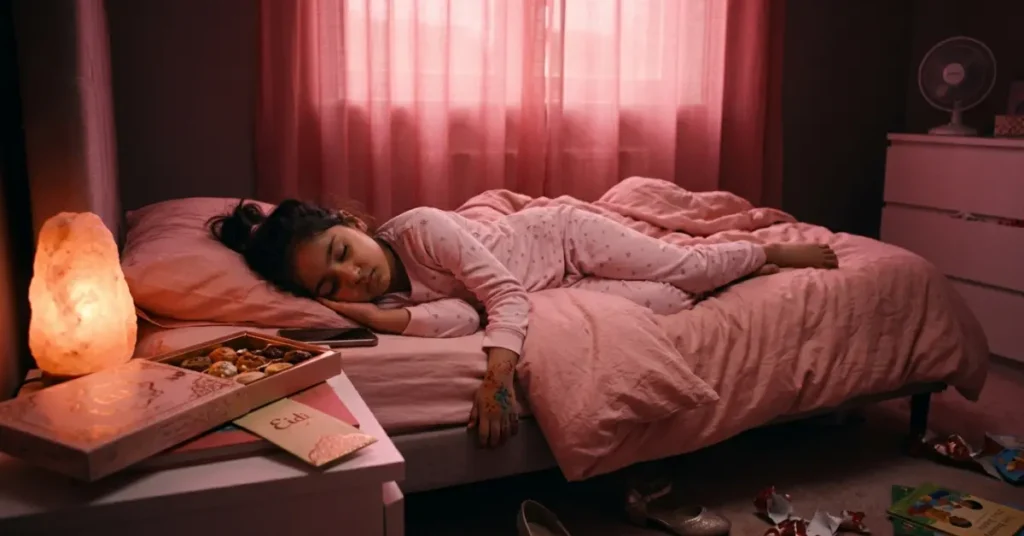
Four factors combine in UAE every May to create the perfect conditions for sleep disruption. None of them on their own would cause serious problems. Together, during the hottest month of the year, during a six-day holiday, they explain everything. The environment during these holidays is a primary driver for child sleep problems.
The Lost Anchor: School Routine
During term time, the school day acts as the body clock’s anchor. Fixed wake-up time, fixed meals, fixed physical activity. The body knows what time it is because every day follows the same structure. When school ends, that anchor is gone. According to the American Academy of Sleep Medicine, consistent sleep and wake schedules are one of the most important factors in children’s sleep quality. When those schedules disappear entirely during a holiday, the body clock drifts quickly and noticeably. Without a routine, families often struggle with escalating child sleep problems.
The Heat
The ideal sleep temperature for children is between 18 and 22 degrees Celsius. In UAE in May, bedroom temperatures without adequate AC can reach 28 to 32 degrees Celsius even at night, well above what allows the body to fall into deep, restorative sleep. Heat prevents the core body temperature drop that triggers the onset of deep sleep. A child lying in a warm room is physiologically fighting against sleep even when they are exhausted. Temperature regulation is vital for preventing heat-induced child sleep problems.
The Screens
Blue light from screens suppresses melatonin, the hormone that signals the brain it is time to wind down. A PMC study on screen time and sleep in school-aged children found that escalating screen time is consistently correlated with delayed sleep onset, shorter sleep duration, and disrupted circadian rhythms. A separate UAE-specific PMC study examining children in Sharjah and Dubai schools found that UAE children’s screen time increases significantly during school holidays, compounding the impact on sleep quality during the exact period when routines are already disrupted. Late-night device usage is a major contributor to modern child sleep problems.
Eid Nights Specifically
Late Eid nights visiting relatives, attending outdoor prayers, and the general excitement of celebrations push bedtime two to three hours past normal. One late night is entirely manageable. Three or four in a row creates what sleep researchers call social jet lag. The body clock shifts significantly, and getting it back requires days of deliberate effort, not just one early bedtime. Social jet lag frequently manifests as persistent child sleep problems in younger children.
How Much Sleep Does My Child Actually Need to Prevent Child Sleep Problems?
Many parents are either too relaxed or too anxious about sleep amounts because they do not know the actual recommended figures. According to the American Academy of Sleep Medicine guidelines, which are also cited in ESMC’s pediatric care guidance, these are the minimum healthy amounts:
| Age Group | Recommended Sleep Per Day | Notes |
|---|---|---|
| Babies 4 to 12 months | 12 to 16 hours | Naps included |
| Toddlers 1 to 2 years | 11 to 14 hours | Naps included |
| Preschool 3 to 5 years | 10 to 13 hours | Naps included |
| School age 6 to 12 years | 9 to 12 hours | Night sleep |
| Teenagers 13 to 18 years | 8 to 10 hours | Night sleep |
In UAE summer, heat disrupts sleep quality and children often wake earlier due to light and rising temperatures. The total hours they actually get frequently falls short of these numbers even when they go to bed at a reasonable time. It is not just about hours in bed. It is about hours of genuine, restorative sleep.
A 6-year-old going to bed at 11 PM and waking at 8 AM is getting 9 hours — just barely enough. But if the room is hot, there were screens until 10:30 PM, and they woke twice in the night, the quality of those 9 hours is nowhere near sufficient. Quality must be prioritized when managing child sleep problems.
What Sleep Deprivation Actually Looks Like in Children
This is the most important thing to understand: overtired children do not look tired. They look and behave in ways that parents consistently misread. If you have been wondering why your child is harder to manage than usual, check this list. Recognizing these signs helps parents differentiate between behavioral issues and child sleep problems.
Hyperactivity and inability to settle. An overtired child who looks wired and energetic is often severely sleep-deprived. The body releases cortisol as a stress response to sleep loss, creating a second-wind effect that looks like energy but is actually exhaustion. The more tired they are, the more hyperactive they appear. This “second wind” is a deceptive symptom of child sleep problems.
Emotional explosions out of proportion. Tantrums over small things, crying at nothing, explosive anger. These are classic signs of a child running on too little sleep. Sleep loss measurably reduces the brain’s ability to regulate emotion, particularly in children whose frontal lobe development is still ongoing. Irritability is often the most visible indicator of child sleep problems in school-aged children.
Difficulty concentrating or following instructions. Noticeable during holiday activities and games, not just schoolwork. If your child seems unusually distracted or forgetful during Eid, sleep is worth examining before anything else. Cognitive fog is a common secondary effect of ongoing child sleep problems.
Increased appetite, especially for sugar. Sleep deprivation increases the hunger hormone ghrelin and decreases the fullness hormone leptin. This is why overtired children suddenly want sweets and snacks constantly during Eid. It is not a phase. It is a direct physiological response to poor sleep. Hormonal shifts linked to appetite are frequently observed in cases of child sleep problems.
Getting sick more often. During sleep, the body actively strengthens the immune system. A child running on inadequate sleep for a week has measurably lower immune function, which is a key reason children tend to fall ill after long holidays. Our guide on recurrent coughs, colds, and ear infections in UAE children explains how holiday-period immune dips contribute to the post-Eid illness spike we see every year at ESMC. Immune suppression is a serious consequence of unresolved child sleep problems.
Clinginess and separation anxiety. Particularly in younger children, sleep deprivation increases emotional insecurity and the need for reassurance in ways that parents often attribute to other causes. Emotional regression often mirrors the severity of underlying child sleep problems.
If your child seems hyperactive, emotional, constantly hungry for sugar, and has been getting sick more than usual — check their sleep before anything else. These are not behavior problems. These are child sleep problems.
The Screen Time Problem: Why You Cannot Just Take the Tablet Away at Bedtime
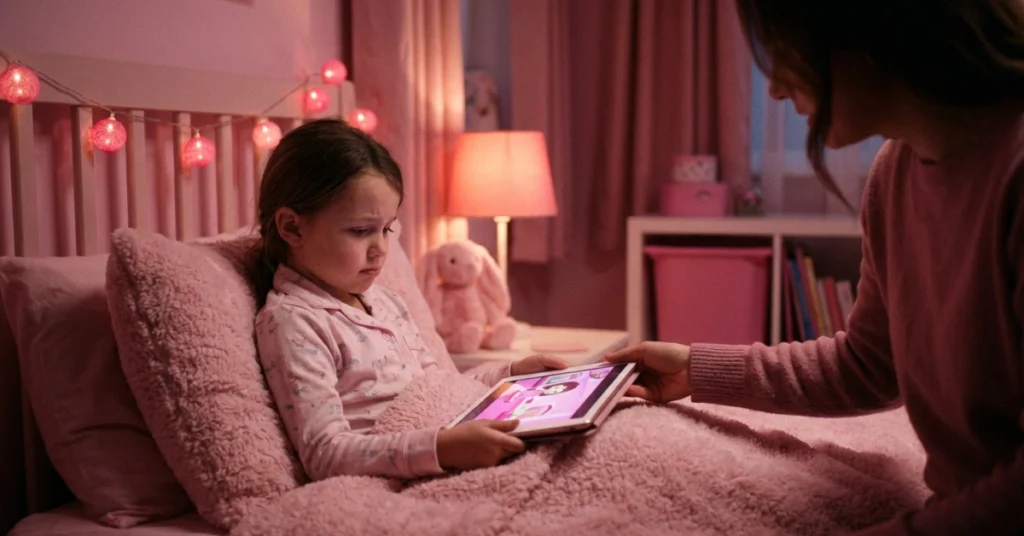
Taking the screen away at 9pm and expecting your child to fall asleep by 9:30 does not work. Here is why. Digital habits are often the most difficult factor to change when correcting child sleep problems.
Blue light from screens suppresses melatonin. According to a clinical review in PMC on screen time and sleep, the effects of this light exposure last approximately 60 to 90 minutes after the screen is turned off. A child who was on a tablet until 9pm has a brain that is physiologically not ready for sleep until 10:30pm, regardless of when they are put to bed.
What actually helps:
Screens off 60 to 90 minutes before sleep. Not 10 minutes. Not when this episode is finished. Sixty to ninety minutes minimum. This is non-negotiable if the goal is resetting the sleep cycle.
Replace the pre-sleep screen window with something genuinely calming: a bath, a book, quiet conversation, colouring, or audio stories. The brain needs a real wind-down period, not a direct transition from a glowing screen to a dark bedroom.
Remove devices from the bedroom entirely. Not just turned off but physically out of the room. According to the American Academy of Pediatrics guidelines on screen time and sleep, a screen-free sleep environment is consistently linked to better sleep quality, better academic performance, and healthier circadian rhythms in children.
Dim the lights in the house 30 to 45 minutes before bedtime. Overhead lighting also suppresses melatonin. Lower, warmer lighting signals nighttime to the brain.
Do not use the screen as a sleep aid. Putting a child to sleep with a video playing quietly is one of the most common habits in UAE households and one of the most disruptive to genuine sleep quality. The brain never fully disengages from ongoing audiovisual stimulation.
The screen is not the enemy. The timing is. Sixty to ninety minutes without a screen before sleep is the single most effective change most UAE families can make tonight. Regulating digital habits is a proven way to reduce child sleep problems.
Heat and Sleep: Making the Bedroom Work in UAE Summer
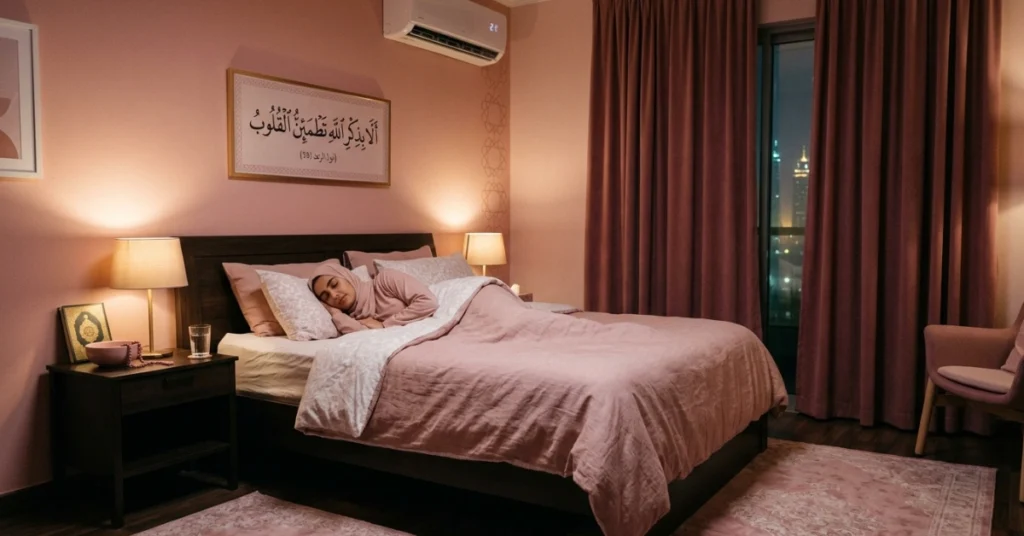
The correct temperature range for children’s sleep is between 18 and 22 degrees Celsius. In UAE summer, this means AC must be running during sleep hours. The concern many parents hold that AC makes children sick is not caused by the temperature itself, but by direct drafts, excessively dry air, and incorrect clothing for the environment. Temperature control remains a cornerstone of managing child sleep problems in the Middle East.
Managing AC safely:
Set AC to 20 to 22 degrees Celsius: cool but not cold. Direct the vent away from the child’s sleeping area using a deflector if needed. Use a light cotton blanket, as the body still benefits from being covered even in AC. Run a small humidifier if the room feels very dry, since AC removes moisture from the air continuously. Optimizing air quality and temperature can significantly decrease child sleep problems.
Blocking daytime heat:
Keep bedroom curtains closed during the day to prevent solar heat buildup. A room that has been hot all day cannot cool to 22 degrees Celsius in 20 minutes. Start the AC at least 30 to 45 minutes before bedtime. Dark curtains or blackout blinds help with both heat retention and early morning light that wakes children at 5 to 6am in UAE summer. Preventing thermal buildup in the bedroom helps avoid late-night child sleep problems.
The early morning wake-up problem:
Many UAE children fall asleep at a reasonable time but wake at 5 to 5:30am because of early morning brightness and rising temperatures. Blackout curtains solve the majority of this problem. If your child is consistently waking too early and this is compounding their sleep debt, blackout blinds are the first thing to address. Environmental control is a key strategy for resolving child sleep problems.
The 5-Day Sleep Reset: How to Get Back to Normal Before School
You cannot move from an 11 PM bedtime to a 7:30 PM bedtime in one night. The body clock does not work that way. Here is how to shift it back gradually. Five days before school returns is enough time to do this properly. This structured approach is designed to systematically eliminate child sleep problems before the school term.
Day 1: Move bedtime 20 to 30 minutes earlier than it has been during the holiday. Do not attempt a dramatic two-hour shift on Day 1. Keep wake-up time the same for now.
Day 2: Move bedtime again by 20 to 30 minutes. It is now 40 to 60 minutes earlier than the holiday norm. Introduce the screen-off rule from tonight: 60 to 90 minutes before the new target bedtime, no exceptions.
Day 3: Move bedtime again and introduce the full routine. Bath, brush, book, bed. A consistent pre-sleep routine acts as a physical signal to the brain that sleep is approaching. Even 15 to 20 minutes of consistent wind-down is enough to begin cueing the body clock. Keep the sequence exactly the same every night.
Day 4: Shift wake-up time earlier. Set the morning alarm 30 minutes earlier than it has been. Children’s body clocks are reset by anchoring wake-up time, not just bedtime. Immediate morning light exposure after waking helps reset the circadian rhythm faster than any other single tool.
Day 5: Hold the new time firmly. By Day 5, the body clock should have shifted significantly. This is the hardest day. The child will resist. Hold the routine. Do not give in to one late night that resets the whole process.
Once school starts, the fixed wake-up time does the rest of the work within one to two weeks.
The single most powerful tool for resetting a child’s sleep is morning light. Open the curtains immediately when you wake your child. Ten minutes of natural morning light resets the body clock faster than any other intervention. Following this structured plan is the most effective way to eliminate child sleep problems before school starts.
Age-by-Age Quick Tips
Babies and Toddlers (under 3) Keep naps at a consistent time even during holidays. Never skip the nap to force an earlier bedtime — it usually backfires and creates an overtired, harder-to-settle child. Bath, feed, darkness, and quiet is the most reliable pre-sleep sequence at this age. If AC is on, dress in a light cotton sleep suit rather than a heavy babygrow. Blackout blinds are worth every dirham for this age group in UAE summer.
Preschool (3 to 5 years) At this age, routine is everything. Even a 10-minute bedtime story in the same order every night is enough to cue sleep effectively. If they napped today, push bedtime 30 minutes later. If no nap, keep bedtime earlier to prevent over tiredness. A simple breathing exercise — breathe in slowly, breathe out slowly — can help anxious little ones settle when the holiday excitement is still buzzing. No screens in the bedroom ever. Routine-based strategies are highly effective for this age group’s child sleep problems.
School Age (6 to 12 years) These children are old enough to understand the reset plan. Explain it to them and why it matters, including the connection between sleep and how they feel during the day. Give them a role: let them choose the bedtime book, or set the alarm themselves. A shared family screen basket works well for creating screen-free bedrooms without conflict. Physical activity during the day is one of the most effective sleep aids at this age. Even 30 minutes of movement meaningfully improves sleep onset. Involving the child in the process helps them take ownership of solving their child sleep problems.
When to See a Pediatrician About Sleep
Most holiday sleep disruption in children resolves within one to two weeks of returning to routine. However, some situations need professional assessment.
Come to ESMC’s Pediatrics Department if:
- Sleep problems persist for more than two weeks after school has returned and the routine is consistently in place
- Your child is snoring loudly or appears to briefly stop breathing during sleep. This needs assessment for sleep apnoea
- Your child wakes screaming inconsolably one to two hours after falling asleep. This describes night terrors, which are different from nightmares and have specific clinical management
- Your child is consistently sleeping far less than their age-appropriate minimum despite all home strategies
- Your child’s behaviour, mood, or focus has deteriorated significantly and is affecting daily functioning
- Your child has started wetting the bed again after a period of dryness. Sleep deprivation can trigger regression in toilet training. Our specialists are trained to diagnose the root causes of complex child sleep problems.
Loud, regular snoring in a child is never normal. It is always worth a pediatric assessment. Our team at ESMC Sharjah can evaluate whether your child’s sleep problems have an underlying cause that needs treatment. Seeking expert advice is crucial when child sleep problems impact a child’s health.
If your child is also showing signs of dehydration or overheating alongside sleep difficulties during the Eid break, read our guide on dehydration signs in children in UAE which covers how heat-related fluid loss affects children’s behavior and energy levels in UAE summer.
Book a Pediatric Consultation at ESMC Sharjah
Frequently Asked Questions
Is it normal for my child to stay up until midnight during Eid?
Yes, within reason. One or two late nights during Eid celebrations are completely normal and nothing to worry about. The problem arises when late nights become the consistent pattern for four to six days in a row. At that point, the body clock shifts significantly and getting back to normal requires deliberate effort. It does not happen on its own, and the longer it is left, the harder the reset becomes. Occasional late nights should not be allowed to morph into chronic child sleep problems.
My child seems fine on less sleep. Do they really need those recommended hours?
Children are significantly better than adults at masking the effects of poor sleep. The hyperactivity, emotional outbursts, and sugar cravings you are already seeing are the signs — they just do not look like tiredness. The recommended hours from the American Academy of Sleep Medicine are based on research into brain development, immune function, emotional regulation, and growth. Even children who seem fine benefit measurably from adequate sleep.
Should I use melatonin supplements to reset my child’s sleep?
Melatonin is a clinical decision and should only ever be used under pediatric guidance. For most healthy children recovering from holiday sleep disruption, melatonin is not necessary. The 5-day gradual reset plan, combined with screen-off time and morning light exposure, is highly effective on its own for the vast majority of children. If you are considering melatonin, speak to the pediatric team at ESMC Sharjah before starting. Professional guidance is always recommended when using supplements to manage child sleep problems.
Is it okay to let my child nap during the day to catch up on sleep?
It depends on age. For children under five, naps are genuinely important and skipping them to force an earlier bedtime usually backfires — they become overtired and harder to settle. For children aged six and above, daytime napping during the reset period can interfere with nighttime sleep and delay the process. If a school-age child is very tired, a short 20-minute rest before 3pm is acceptable, but long afternoon naps should be avoided during the routine reset week.
My child wakes up screaming in the night. Is this a nightmare or something else?
It depends on when it happens. Night terrors occur one to two hours after falling asleep, during deep non-REM sleep. The child appears distressed and may scream or thrash but is not truly awake and will have no memory of the episode. Nightmares happen later in the night during REM sleep, and children typically wake from them and remember them. Both are more common in sleep-deprived children. If night terrors are frequent or distressing, the pediatric team at ESMC Sharjah can advise on management. Distinguishing between these events is crucial for the clinical management of child sleep problems.
How long will the sleep reset actually take?
For most children who have had disrupted sleep over a five to seven day holiday period, a consistent 5-day gradual reset is enough to substantially shift the body clock back. Once school starts and wake-up time is fixed, the body clock typically completes its adjustment within one to two weeks. If sleep problems persist beyond two weeks of school returning with the routine in place, it is worth a pediatric assessment at ESMC.
My child has been getting sick after every Eid for the past two years. Is this connected to sleep?
Very likely yes. Sleep deprivation measurably reduces immune function in children. A child running on inadequate sleep for five to seven days during Eid has a noticeably lowered ability to fight off the viruses they encounter at family gatherings and when school returns. Our guide on recurrent coughs, colds, and ear infections in UAE children covers the immune connection in detail and explains when a pattern of post-holiday illness warrants a clinical review.
Can the Eid sleep disruption affect my child’s behavior at school when they return?
Yes, significantly. A cross-sectional analysis published in PMC found that sleep disruption is consistently linked to reduced concentration, poorer academic performance, and increased behavioral difficulties in school-age children. Teachers across UAE schools consistently report a visible dip in focus and behaviour in the first week after Eid and long summer holidays. Starting the 5-day reset plan five days before school returns means your child arrives back in class with a body clock that is already substantially adjusted. Proactive management of child sleep problems ensures a smoother academic transition for the child.
The Bottom Line
Holiday sleep chaos is real, it is universal among UAE parents, and it passes. The combination of Eid late nights, UAE summer heat, and screens is a genuinely disruptive cocktail. But it is one with a straightforward antidote: a gradual routine reset, a cool dark room, screens off well before bed, and morning light first thing. Parents should feel empowered to take control of their family’s child sleep problems.
Children’s sleep disruption during Eid break in UAE responds faster than most parents expect once the right conditions are consistently in place. With the right approach, child sleep problems can be resolved quickly and effectively.
Start tonight. Move bedtime by 20 minutes. Turn off screens 90 minutes before sleep. Open the curtains the moment they wake in the morning. That is Day 1 done.
If you need expert assistance, our clinic is ready to help you navigate your child sleep problems. And if you need us, the pediatric team at ESMC Sharjah is here. If your child’s sleep is not improving, or if something feels like more than holiday disruption, do not wait.
Open 8AM to 11:30PM daily. Al Zahra Street, Maysaloon, Sharjah.