Your doctor handed you a referral slip at the end of your appointment. It says ultrasound. Underneath that, it says abdominal, pelvic, or thyroid. You are not sure exactly what that means, what you need to do before you go, or whether you need to fast. You Googled the scan name and got a confusing medical article. You want someone to just tell you, clearly, what happens when you walk into the radiology room.
Ultrasound scan UAE appointments at Erum Saba Medical Center (ESMC) are available for all eight types of diagnostic imaging our Radiology Department at ESMC offers. This guide explains every type, exactly what each one checks, what you need to do to prepare, what the experience is like, and the exact price. No jargon. No waiting room anxiety. Just the practical information you need before you come in.
Table of Contents
What an Ultrasound Scan Is and How It Works
Ultrasound uses high-frequency sound waves, not radiation, to create real-time images of internal organs, tissues, and blood flow. A small handheld device called a transducer is placed on the skin over the area being examined. The transducer emits sound waves that bounce off internal structures and return as signals that the machine converts into a moving image on a screen.
Because ultrasound uses sound waves rather than radiation, it is completely safe for pregnant women, children, and adults of all ages, as confirmed by international global health organizations such as the World Health Organization (WHO). There is no exposure to X-ray radiation, and no injection is required for a standard ultrasound. Most scans are entirely non-invasive, though transvaginal and internal scans use a slim probe that is explained and consented before use.
At ESMC Sharjah, all ultrasound scans are performed by Dr. Hala Eltayeb Ibrahim, our Specialist Diagnostic Radiologist with over 15 years of experience across Sudan and the UAE, who is fully DHA licensed and MOH licensed.
The 8 Types of Ultrasound Scan at ESMC: What Each One Checks
Here is a clear breakdown of the eight diagnostic ultrasound scans performed at ESMC Sharjah, including what each detects, who needs it, and how to prepare.
1. Abdominal Ultrasound: AED 350
- What it checks: Liver, gallbladder, spleen, pancreas, and abdominal aorta. It detects gallstones, liver enlargement, fatty liver disease, cysts, abdominal masses, and fluid in the abdomen. It is ordered by GPs and specialists when a patient has unexplained abdominal pain, bloating, jaundice, or abnormal liver function tests.
- Preparation: Fast for 4 to 6 hours before the scan. Plain water is permitted. A full stomach obscures abdominal organs with gas and limits image quality.
2. Pelvic Ultrasound: AED 350
- What it checks: Uterus, ovaries, fallopian tubes, and bladder in women. It detects fibroids and polyps in UAE, ovarian cysts, PCOS, endometriosis signs, and uterine abnormalities. In men, it assesses the bladder and prostate. It is ordered for pelvic pain, irregular periods, fertility investigation, and routine gynaecological assessment with a specialist like Dr. Erum Saba.
- Preparation: A full bladder is required for a transabdominal pelvic scan. Drink 1 litre of water one hour before and do not urinate. A transvaginal pelvic scan requires an empty bladder and is performed with a slim internal probe for clearer imaging of the uterus and ovaries.
3. Thyroid Ultrasound Scan: AED 350
- What it checks: Size, shape, and texture of the thyroid gland in the neck. It detects thyroid nodules, goitre, cysts, and thyroid enlargement. It is ordered when blood tests show abnormal thyroid hormone levels, when a lump is felt in the neck, or as part of a thyroid condition monitoring plan.
- Preparation: No preparation required. The scan takes 15 to 20 minutes. Wear a low neckline or open-collar shirt.
4. KUB Scan (Kidney, Ureter, Bladder): AED 350
- What it checks: Both kidneys, the ureters, and the bladder. It detects kidney stones, kidney enlargement or shrinkage, cysts, hydronephrosis (fluid buildup in the kidney), bladder abnormalities, and urinary tract structural issues. It is ordered for flank pain, blood in urine, recurrent urinary infections, or abnormal kidney function tests.
- Preparation: A full bladder is required. Drink 1 litre of water one hour before and do not urinate. Avoid gas-producing foods for 24 hours before the scan where possible.
5. Breast Ultrasound: AED 350
- What it checks: Breast tissue to identify lumps, cysts, solid masses, and abnormal lymph nodes in the armpit. According to clinical studies published by the National Institutes of Health (NIH), it is particularly useful for younger women under 35 whose denser breast tissue limits mammography accuracy. It is ordered after a breast lump is felt, after an abnormal mammogram finding, or as a screening tool for women with dense breast tissue or a family history of breast cancer.
- Preparation: No preparation required. Avoid applying deodorant, lotion, or powder under the arms or on the breast area on the day of the scan.
6. NT Scan (Nuchal Translucency Scan): AED 300
- What it checks: The fluid-filled space at the back of the baby’s neck between weeks 11 and 13 of pregnancy. Based on guidelines from the Royal College of Obstetricians and Gynaecologists (RCOG), an increased nuchal translucency measurement can indicate a higher risk of chromosomal conditions, including Down syndrome. Combined with blood tests at this stage, it forms the first trimester combined screening. This is the first detailed pregnancy scan and a significant milestone for expectant parents following a complete guide to antenatal care in UAE.
- Preparation: A moderately full bladder is recommended. The scan takes 20 to 30 minutes. It must be booked strictly between gestational weeks 11 and 13 plus 6 days.
7. Anomaly Scan: AED 350
- What it checks: A detailed assessment of the baby’s anatomy between weeks 18 and 22 of pregnancy. It examines the brain, spine, heart, kidneys, limbs, abdominal wall, and face. It measures the baby’s growth and confirms placental position and amniotic fluid levels. The anomaly scan is the most comprehensive pregnancy scan and the one most expectant parents look forward to most.
- Preparation: No specific preparation required. A light meal beforehand is fine. Wear comfortable, loose clothing for easy abdominal access.
8. Growth Scan: AED 350
- What it checks: Baby’s weight, position, and growth trajectory from week 28 onwards. It measures head circumference, abdominal circumference, and femur length to calculate estimated fetal weight. It assesses amniotic fluid volume and placental function. It is ordered in the third trimester, more frequently for high-risk or multiple pregnancies.
- Preparation: No specific preparation required.
Summary of Ultrasound Scans at ESMC Sharjah
| Scan Type | What It Checks | Preparation Needed | Price at ESMC |
| Abdominal Ultrasound | Liver, gallbladder, spleen, pancreas | Fast 4 to 6 hours | AED 350 |
| Pelvic Ultrasound | Uterus, ovaries, bladder | Full bladder | AED 350 |
| Thyroid Ultrasound | Thyroid gland in neck | None | AED 350 |
| KUB Scan | Kidneys, ureters, bladder | Full bladder | AED 350 |
| Breast Ultrasound | Breast tissue and lymph nodes | None | AED 350 |
| NT Scan | Nuchal translucency (weeks 11 to 13) | Moderately full bladder | AED 300 |
| Anomaly Scan | Full fetal anatomy (weeks 18 to 22) | None | AED 350 |
| Growth Scan | Fetal growth and position (week 28+) | None | AED 350 |
Important Callout: Full Bladder Requirement
If you are booked for a Pelvic or KUB ultrasound scan, you must arrive with a fully distended bladder. Drink 1 litre of water (about 3 to 4 glasses) one hour before your appointment time and do not urinate. Sound waves travel clearly through fluid, allowing the radiologist to see behind the bladder to view pelvic organs and kidney structures. Arriving with an empty bladder will result in unclear images and may require your scan to be rescheduled.
What Happens During an Ultrasound Scan at ESMC
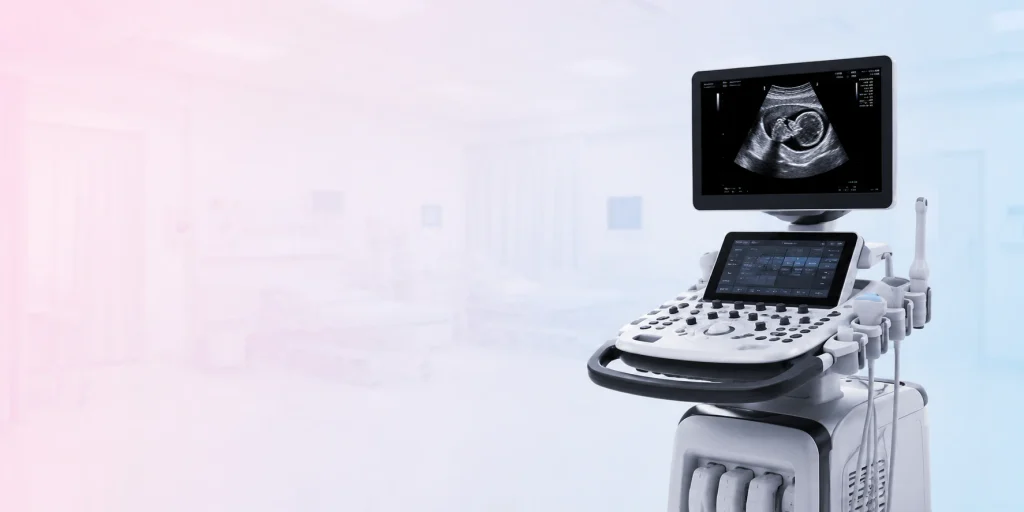
You arrive at ESMC and check in at reception. You are taken to the radiology room by Dr. Hala Eltayeb Ibrahim’s team. You lie on a comfortable examination table. A small amount of water-based gel is applied to the skin over the area being scanned. The gel is warm or room temperature, not cold.
The transducer is moved gently across the gel-covered skin. You see a live image on the monitor screen beside the table. The scan itself takes between 15 and 40 minutes depending on the type.
After the scan is complete, the gel is wiped off with a tissue. For most scans, you can dress and return to normal activity immediately. There is no recovery time and no after-effects.
For pregnancy scans, Dr. Hala will explain the key findings during the scan. You will receive a written radiology report and scan images to take with you.
If you are coming for a pelvic or KUB scan, arrive with a full bladder. Do not urinate before the scan. If your bladder is not adequately full, the scan may need to be rescheduled.
UAE-Specific Considerations
No referral is required at ESMC. In many UAE hospitals and larger clinics, diagnostic scans require a specialist referral. At ESMC Sharjah, you can book an ultrasound scan directly without a referral if you have a personal health concern you want investigated. Walk-ins are welcome. Call or WhatsApp +971506659064 to confirm same-day availability.
Same-day availability is a major priority for us. ESMC is open from 8:00 AM to 11:30 PM daily including weekends and public holidays. If you receive a referral from your GP today, you may be able to complete your ultrasound at ESMC the same day rather than waiting for a hospital appointment that may be weeks away.
Pregnancy scan timing is critical in UAE summer and holiday seasons. The NT scan must be performed strictly between weeks 11 and 13 plus 6 days. Missing this window means the scan cannot be performed and first trimester chromosomal screening is delayed. Do not postpone booking your NT scan. If you are unsure of your gestational age, contact ESMC and we can advise.
Privacy and all-female options are fully assured. For women requiring pelvic or breast ultrasound, ESMC’s all-female clinical environment provides a fully private and comfortable setting. Dr. Hala is female, and female staff are available throughout your visit.
How to Book Your Ultrasound Scan at ESMC
Walk-ins are welcome daily from 8:00 AM to 11:30 PM. For same-day or pre-booked appointments, call or WhatsApp +971506659064.
You do not need a GP referral to book directly. If you have a referral, bring it with you along with any previous scan reports or blood test results related to your concern.
What to bring with you:
- Your Emirates ID or passport.
- Any referral letter from your doctor.
- Previous scan reports if applicable.
- A printed or digital copy of your insurance card if you intend to use insurance.
Insurance Coverage Information
Most UAE health insurance plans cover diagnostic ultrasound scans when accompanied by a clinical referral. Contact ESMC’s reception team to confirm your plan’s network coverage before your appointment.
Book your ultrasound scan directly at ESMC Sharjah today.
Frequently Asked Questions
Do I need a doctor’s referral to book an ultrasound at ESMC Sharjah?
No, a doctor’s referral is not mandatory to book an ultrasound scan at ESMC. While many patients come with a referral slip from their GP or specialist, you can book a scan directly if you have a personal health concern you wish to evaluate. However, if you plan to claim the cost through UAE health insurance, your insurer will typically require a written clinical referral from a licensed physician.
How long does an ultrasound scan take?
Most routine ultrasound scans at ESMC take between 15 and 30 minutes to complete. Specialized scans, such as a detailed second-trimester anomaly scan, may take 30 to 40 minutes because the radiologist evaluates every anatomical structure of the fetus. You should plan to arrive 15 minutes before your scheduled appointment time for registration.
Is ultrasound safe during pregnancy?
Yes, ultrasound is entirely safe during pregnancy according to health authorities such as the World Health Organization (WHO) and the UK National Health Service (NHS). Unlike X-rays or CT scans, ultrasound technology relies exclusively on high-frequency sound waves to create images. It does not use ionizing radiation, posing zero exposure risk to you or your developing baby.
What is the difference between a transabdominal and a transvaginal ultrasound?
A transabdominal ultrasound is performed externally by moving the transducer over the gel-covered skin of your lower abdomen, requiring a full bladder for clear visualization. A transvaginal ultrasound is an internal scan where a slim, lubricated probe is inserted gently into the vagina with an empty bladder. Transvaginal scans provide much higher-resolution images of the uterus and ovaries and are ideal for early pregnancy or detailed gynaecological evaluations.
Can I eat before my ultrasound scan?
Eating rules depend entirely on the type of scan you are having. For an abdominal ultrasound, you must fast for 4 to 6 hours prior to the exam because food digestion generates gas that blocks sound waves and obscures the gallbladder and pancreas. For pelvic, thyroid, breast, KUB, and pregnancy scans, you may eat normally before your appointment.
How much does an ultrasound scan cost in Sharjah?
At Erum Saba Medical Center in Sharjah, an NT scan costs AED 300, while abdominal, pelvic, thyroid, KUB, breast, anomaly, and growth scans cost AED 350 each. Our pricing is transparent and competitive compared to hospital settings across Sharjah and Dubai. We aim to make specialist diagnostic imaging accessible to all residents.
Will I get my results on the same day?
Yes, Dr. Hala Eltayeb Ibrahim will discuss the preliminary findings with you immediately following your scan. You will receive your official printed radiology report along with high-resolution scan images to take to your treating physician on the same day. This ensures zero delay in receiving proper medical follow-up or treatment.
What should I wear to my ultrasound appointment?
We recommend wearing comfortable, loose-fitting two-piece clothing, such as a top with trousers or a skirt. This allows easy access to the area being examined, such as your abdomen, neck, or chest, without needing to fully change into a medical gown. If you are having a thyroid scan, wear an open-collar shirt or low neckline.
Is a breast ultrasound the same as a mammogram?
No, a breast ultrasound uses sound waves to evaluate breast tissue, whereas a mammogram uses low-dose X-rays. Breast ultrasound is highly effective at distinguishing fluid-filled cysts from solid masses and is the preferred imaging choice for women under 35 with dense breast tissue. Mammograms are typically recommended as a primary screening tool for women over 40.
I have been told I need a KUB scan. What does that mean?
KUB stands for Kidneys, Ureter, and Bladder. It is a targeted ultrasound examination designed to evaluate the upper and lower urinary tract system. A KUB scan looks for structural abnormalities, kidney stones, urinary blockages, cysts, and signs of chronic infection. It requires a full bladder for accurate imaging of the bladder walls and lower ureters.
Ready to Schedule Your Scan?
Whatever brought you to this page, whether it is a doctor’s referral, a personal health concern, or a pregnancy you want to monitor carefully, the ultrasound scan UAE team at ESMC is ready to help. Eight scan types. Same-day availability. Walk-ins welcome. Open every day from 8:00 AM to 11:30 PM. There is no reason to wait for a hospital appointment that is weeks away when the diagnostic imaging you need is available today.
Book Your Ultrasound Scan at ESMC Sharjah Now
Visit us at Al Owais Building, Flat 206, Block A, Jaber Bin Hayan Street, Al Zahra Street, Maysaloon, Sharjah.
Open 8:00 AM to 11:30 PM daily.