You are eight weeks pregnant, sitting on your sofa in UAE with your antenatal file resting on your lap. Your obstetrician has given you a list of ultrasound appointments to book over the coming months. An NT scan at week 12, an anomaly scan at week 20, and a growth scan from week 28 onwards. Each scan name is followed by a strict window of dates and a note reminding you not to miss the appointment.
You have searched each scan online and found a confusing mix of dense medical papers and forum posts that leave you feeling more anxious than informed. You want someone to explain in plain language what each scan is checking, when to book, and what you will see on the screen. Booking a pregnancy scan UAE at Erum Saba Medical Center (ESMC) allows you to complete all three key ultrasound milestones under the care of Dr. Hala Eltayeb Ibrahim, Specialist Diagnostic Radiologist. This guide breaks down each scan step by step, covering what it checks, how to prepare, and what it costs.
Table of Contents
Why Pregnancy Scans Matter and What They Cannot Tell You
Pregnancy scans provide a detailed visual assessment of fetal development at specific gestational windows. They are among the most essential tools in modern antenatal care and offer parents a comforting connection to their growing baby. Royal College of Obstetricians and Gynecologists (RCOG) guidance confirms that routine ultrasound in pregnancy assesses structural development, screen for physical conditions, and track growth.
It is equally important to understand what pregnancy scans cannot do. An ultrasound scan cannot guarantee that a baby will be born completely free of health conditions. Ultrasound imaging detects many structural and anatomical variations, but some genetic, metabolic, or functional conditions do not show visible physical signs on an ultrasound screen.
A normal scan result offers strong reassurance, but it is not an absolute medical guarantee. The three scans detailed in this guide form the foundation of routine antenatal imaging. Each scan serves a specific clinical purpose during a window of time that cannot be extended.
The NT Scan: Week 11 to Week 13 (+6 Days)
The nuchal translucency (NT) scan is the earliest detailed screening ultrasound of your pregnancy. It must be performed between 11 weeks 0 days and 13 weeks 6 days of gestation. This tight booking window cannot be extended under any circumstances. Before week 11, the baby is too small for precise measurement. After week 13 and 6 days, the fluid at the back of the neck is reabsorbed by the lymphatic system, making accurate screening impossible.
URGENT BOOKING WINDOW: WEEKS 11 TO 13 (+6 DAYS)
Do not delay booking your NT scan. Once you reach 14 weeks, the
Nuchal fluid measurement can no longer be used for screening.
What the NT Scan Checks
During the NT scan, Dr. Hala Eltayeb Ibrahim measures the fluid-filled space at the back of the baby’s neck, known as the nuchal fold. According to NHS guidance on first trimester screening, an increased nuchal translucency measurement can indicate a higher statistical chance of chromosomal conditions, including Down syndrome (trisomy 21), Edwards syndrome (trisomy 18), and Patau syndrome (trisomy 13). When combined with a maternal blood test measuring PAPP-A and free beta-hCG, this ultrasound forms the first trimester combined screening.
Beyond nuchal fluid measurement, the NT scan performs several vital early health checks:
- Confirms Viability and Heartbeat: Visualizes the cardiac movement and confirms the pregnancy is progressing safely.
- Establishes Accurate Gestational Age: Measures the crown-rump length (CRL) from the top of the baby’s head to their bottom to calculate an accurate due date.
- Determines Multiple Gestations: Identifies whether you are carrying twins or triplets and checks early placental arrangement.
- Early Structural Check: Evaluates early development of the skull, abdominal wall, and limbs.
Understanding Your NT Scan Results
The nuchal translucency measurement is recorded in millimetres. A measurement under 3.5 mm is generally considered within the typical range for most gestations. It is important to know that an NT scan result is not a definitive diagnosis. It provides a statistical risk ratio by comparing your scan measurement, your blood test values, and your age.
A higher-risk statistical result does not mean your baby has a chromosomal condition. It simply indicates that further diagnostic evaluation, such as Non-Invasive Prenatal Testing (NIPT) or an amniocentesis, may be discussed with your specialist. If you have experienced pregnancy loss in the past, understanding these early screening markers can form part of a broader evaluation for recurrent miscarriage in UAE.
Preparation and Cost
To prepare for an NT scan, a moderately full bladder is recommended because fluid in the bladder helps tilt the uterus into a clearer viewing angle. Drink half a litre of water 30 minutes before your appointment. The appointment takes between 20 and 30 minutes.
At Erum Saba Medical Center, the NT scan costs AED 300. If you are unsure of your exact gestational age, contact our team, and we will help calculate your scan window based on your last menstrual period.
The Anomaly Scan: Week 18 to Week 22
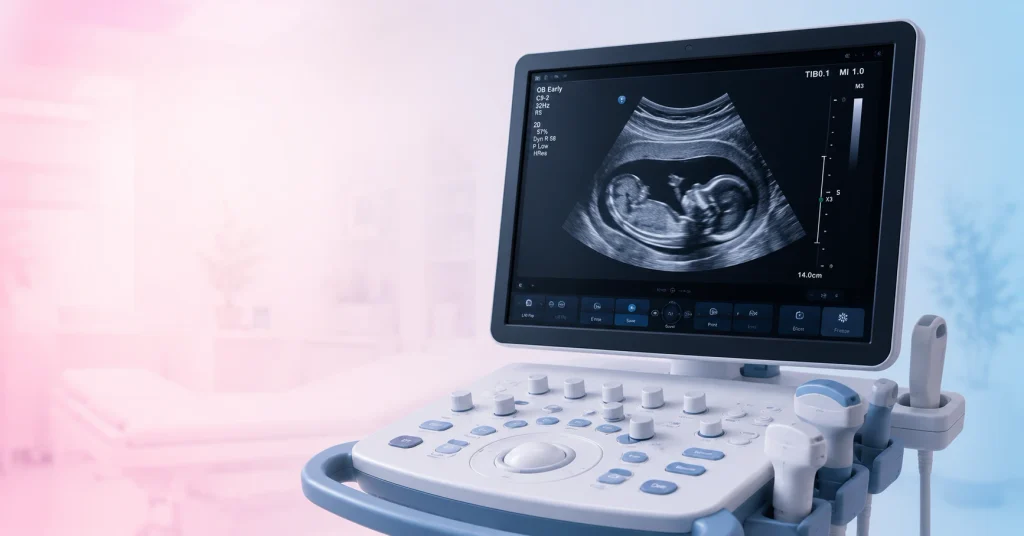
The anomaly scan, often called the mid-pregnancy ultrasound or 20-week scan, is the most thorough anatomical assessment of your baby. For many parents, this appointment is an emotional highlight because the baby is fully formed and clearly visible on the screen.
What the Anomaly Scan Checks
During this detailed scan, the radiologist systematically examines every major organ system from head to toe. Following standard NHS anomaly screening protocols, the assessment includes:
- Brain and Skull: Checks the shape of the skull, brain ventricles, and cerebellum.
- Face and Profile: Evaluates the upper lip and nose line to check for cleft lip.
- Spine: Examines the vertebrae in longitudinal and cross-section views to rule out open neural tube defects like spina bifida.
- Heart: Assesses the four chambers, outflow tracts, and major blood vessels supplying the lungs and body.
- Abdomen and Organs: Confirms the presence and structure of the stomach, kidneys, bladder, and abdominal wall.
- Limbs and Extremities: Measures the long bones of the arms and legs and checks the presence of hands and feet.
- Placenta and Fluid: Checks placental position relative to the cervix and measures amniotic fluid levels.
CAN THE ANOMALY SCAN REVEAL THE BABY’S GENDER?
Yes. In most cases between 18 and 22 weeks, gender can be seen
clearly if the baby is in a favorable position. Please let
Dr. Hala know at the start of your scan if you wish to know.
What the Scan Can and Cannot Identify
The anomaly scan reliably identifies major structural conditions, including severe heart malformations, spina bifida, abdominal wall defects, and renal abnormalities. However, ultrasound has natural limitations. Minor structural variations, subtle heart defects, or conditions that develop late in pregnancy may not be visible at 20 weeks. A clear anomaly scan provides excellent reassurance, but it cannot rule out every possible health concern.
Preparation and Cost
No special preparation is needed for an anomaly scan. You do not need a full bladder. Eat a light meal before your visit, as a small amount of natural sugar can encourage the baby to move into an accessible position. Wear comfortable, two-piece clothing for easy abdominal access. The scan takes between 30 and 45 minutes.
At Erum Saba Medical Center, the anomaly scan costs AED 350.
The Growth Scan: Week 28 Onwards
Unlike the NT and anomaly scans, which occur at specific one-off windows, a growth scan is performed during the third trimester and may be repeated depending on your clinical needs. From week 28 through to delivery, growth scans track your baby’s weight, physical development, and overall intrauterine environment.
What the Growth Scan Checks
A third-trimester growth scan focuses on biometric measurements to ensure your baby is growing along an expected curve. The measurements recorded include:
- Head Circumference (HC): Measures the size and proportion of the baby’s head.
- Abdominal Circumference (AC): Reflects glycogen storage in the liver and soft tissue growth.
- Femur Length (FL): Measures the length of the thigh bone to assess long bone growth.
- Estimated Fetal Weight (EFW): Combines HC, AC, and FL to calculate current weight and plot it on a standardized growth chart.
- Amniotic Fluid Index (AFI): Measures fluid pockets surrounding the baby to verify kidney function and placental health.
- Doppler Ultrasound: Evaluates blood flow through the umbilical artery when closer monitoring of placental function is needed.
Why Growth Scans May Be Repeated
According to RCOG guidelines on fetal growth monitoring, additional growth scans are recommended for pregnancies affected by maternal hypertension, gestational diabetes, previous low birth weight, reduced fetal movements, or a low-lying placenta. If your baby is measuring smaller or larger than expected, your obstetrician may request serial growth scans every two to four weeks to track the trajectory over time.
If your pregnancy requires closer medical observation, reading our detailed guide on high-risk pregnancy UAE will help you understand how third-trimester monitoring works.
Preparation and Cost
No preparation is necessary for a third-trimester growth scan. The session takes 20 to 30 minutes. At Erum Saba Medical Center, each growth scan costs AED 350.
Pregnancy Scan Timeline Overview
Here is a simple breakdown of the three main pregnancy scans available at ESMC Sharjah:
| Scan Name | Gestational Window | Primary Clinical Focus | Preparation Required | Price at ESMC |
| NT Scan | Weeks 11 to 13 (+6 days) | Nuchal fluid, chromosomal risk ratio, due date confirmation, viability | Moderately full bladder (500 ml water) | AED 300 |
| Anomaly Scan | Weeks 18 to 22 | Full anatomical check (brain, heart, spine, organs, limbs, placenta) | None (light meal beforehand helps) | AED 350 |
| Growth Scan | Week 28 to delivery | Fetal weight, biometry, amniotic fluid volume, placental function | None | AED 350 |
What to Expect on the Day of Your Scan at ESMC
When you arrive at Erum Saba Medical Center on Al Zahra Street in Maysaloon, you will check in at reception before being escorted to our dedicated imaging suite. You will lie comfortably on a cushioned examination table while warm ultrasound gel is applied to your lower abdomen.
Dr. Hala Eltayeb Ibrahim will gently move the transducer over your abdomen. A secondary monitor is positioned directly facing you, allowing you to watch your baby in real time as the scan takes place. Dr. Hala will explain what she is examining throughout the procedure, pointing out the heartbeat, physical structures, and growth measurements.
WHAT YOU TAKE HOME AFTER YOUR APPOINTMENT
* Detailed written diagnostic report
* High-resolution 2D ultrasound printouts
* Clear explanation of all measurements and findings
You are welcome to bring your partner or a support person into the scan room. Our radiology suite accommodates one accompanying adult per visit. While ESMC focuses on 2D diagnostic ultrasound, which is the international clinical standard for anatomical accuracy, you will receive printed image records to keep in your pregnancy journal.
UAE-Specific Considerations for Pregnancy Scans in Sharjah
Navigating antenatal appointments as an expat or local resident in Sharjah involves practical decisions around scheduling, language, and clinical integration.
Direct Self-Booking Without a Referral
Unlike hospital radiology departments across Sharjah and Dubai, ESMC does not require a doctor’s referral to schedule a pregnancy scan. If you know your dates and want to book your NT or anomaly scan directly, you can contact us via phone or WhatsApp.
Flexible Appointments and Same-Day Availability
ESMC is open daily from 8:00 AM to 11:30 PM. If you are approaching the end of your 13-week NT window and need an urgent appointment, our extended operational hours mean we can often accommodate same-day bookings.
Ramadan Scheduling Advice
If you are pregnant and fasting during Ramadan, schedule your NT scan during the morning hours. Staying hydrated early in the day makes it easier to maintain a moderately full bladder for optimal imaging clarity. Our staff can help select the best time slot during holy month fasting hours.
Bilingual Consultations and Integrated Care
Dr. Hala speaks fluent Arabic and English, ensuring you receive clear explanations in the language you feel most comfortable speaking. Furthermore, our Radiology Department at ESMC works directly alongside our specialist genecology clinic led by Dr. Erum Saba.
If a scan reveals a finding that requires medical follow-up, an integrated genecology consultation can often be arranged on the same day. This coordinated setup provides reassurance and saves you from booking separate appointments across different clinics. For a complete overview of structuring your pregnancy check-ups, refer to our complete guide to antenatal care in UAE.
When to Book Your Pregnancy Scans at ESMC
To ensure you secure your preferred date and time within the required gestational windows, we recommend following this booking timeline:
- NT Scan: Book as soon as your pregnancy is confirmed. Scheduling early prevents missing the strict 13-week and 6-day deadline.
- Anomaly Scan: Book around week 15 or 16 to secure your appointment between weeks 18 and 22.
- Growth Scan: Schedule based on your obstetrician’s advice. Most uncomplicated pregnancies include at least one growth scan between weeks 28 and 32.
Ready to book your scan? Contact Erum Saba Medical Center directly to reserve your appointment.
Call / WhatsApp: +971 50 665 9064
Location: Al Zahra Street, Maysaloon, Sharjah
Direct Booking: Book Your Pregnancy Scan at ESMC
Frequently Asked Questions
When should I book my NT scan in UAE?
You should book your NT scan as soon as you confirm your pregnancy or during your first early prenatal check-up. The NT scan must take place between 11 weeks 0 days and 13 weeks 6 days of pregnancy. Booking early ensures you secure an appointment within this strict timeframe before the nuchal fluid is reabsorbed.
What happens if I miss the NT scan window?
If you pass 13 weeks and 6 days, the nuchal translucency measurement can no longer be used for chromosomal screening. In this scenario, your doctor may recommend second-trimester blood screening or Non-Invasive Prenatal Testing (NIPT) to evaluate chromosomal risk. An anomaly scan at 18 to 22 weeks will still be performed to check physical structures.
Can I find out the gender of my baby at the anomaly scan at ESMC?
Yes, in most cases the baby’s gender can be identified during the anomaly scan between 18 and 22 weeks. The accuracy depends on the baby’s position during the examination. Please inform Dr. Hala at the beginning of your appointment if you wish to learn the gender or prefer to keep it a surprise.
What does a high NT measurement mean?
An increased NT measurement means there is a higher statistical chance of a chromosomal condition or structural heart variation. It is not a definitive diagnosis. If your measurement is elevated, Dr. Hala and your gynaecologist will explain the results clearly and discuss optional follow-up testing, such as NIPT or diagnostic testing.
Do I need a full bladder for my pregnancy scan?
A moderately full bladder is recommended for the NT scan between 11 and 13 weeks, as it helps lift the uterus for better visual access. You should drink half a litre of water 30 minutes before your NT scan. The anomaly scan and growth scans do not require a full bladder.
How long does the anomaly scan take and will everything be checked in one appointment?
The anomaly scan typically takes between 30 and 45 minutes. Dr. Hala systematically examines the baby’s head, spine, heart, stomach, kidneys, limbs, and placenta. If the baby is lying in a difficult position, you may be asked to walk for 10 minutes or sip cold water to encourage movement before completing the check.
Is it safe to have multiple ultrasound scans during pregnancy?
Yes, diagnostic ultrasound uses high-frequency sound waves rather than ionizing radiation, making it safe for both mother and baby throughout pregnancy. Medical guidelines from the RCOG confirm that routine antenatal ultrasound scans carry no known harmful cumulative risks when performed by qualified medical professionals.
My growth scan showed my baby is measuring small. What does this mean?
If a growth scan indicates your baby is smaller than expected for your gestational age, your doctor will evaluate the result in context. Factors like parental height, placental blood flow, and amniotic fluid levels are reviewed. Your clinician may recommend a repeat growth scan in two weeks alongside Doppler blood flow checks to monitor ongoing development.
Do I need a referral from my obstetrician to book a pregnancy scan at ESMC?
No, you do not need a physician’s referral to book a pregnancy ultrasound at Erum Saba Medical Center. You can book directly by calling or WhatsApping our clinic. If you already have an antenatal file or referral letter from another doctor, you are welcome to bring it with you.
How much do pregnancy scans cost in Sharjah compared to Dubai?
Pregnancy scan fees in Sharjah at standalone medical centers like ESMC are often significantly more affordable than hospital-based radiology units in Dubai. At ESMC, an NT scan costs AED 300, while anomaly and growth scans cost AED 350 each. This provides access to specialist diagnostic care without unnecessary hospital overhead costs.
Book Your Pregnancy Scan at ESMC Sharjah
Your pregnancy scans are among the most memorable milestones of your antenatal care. Each scan provides reassurance, valuable clinical details, and a clear view of your baby’s development. At Erum Saba Medical Center, our goal is to deliver precise diagnostic imaging in a calm, welcoming, and supportive setting. Whether you are scheduling your early NT scan or booking a third-trimester growth check, our team is here to guide you through every step.
Book Your Ultrasound Scan at ESMC Sharjah Now
Visit us at Al Owais Building, Flat 206, Block A, Jaber Bin Hayan Street, Al Zahra Street, Maysaloon, Sharjah.
Open 8:00 AM to 11:30 PM daily including weekends to keep your little ones healthy and active.