
Baby development milestones in UAE are something every new parent ends up Googling at 11 PM, usually with a specific and slightly panicked search. Your baby is 4 months old and your neighbor’s baby, also 4 months, is already rolling. Yours is not. The WhatsApp group has not helped. Someone said it is fine. Someone else said their baby rolled at 10 weeks. You have been searching for developmental delay for 40 minutes and you are not sure whether to call the clinic tomorrow or wait another month.
This is one of the most universal experiences of first-year parenting in UAE where new parents have a smartphone and a restless mind at midnight.
The good news is that most of this anxiety dissolves almost entirely once you understand what the actual clinical ranges are. Not what your neighbor’s baby did. Not what the parenting app says. What the evidence-based developmental windows actually show, month by month, for the first year of your baby’s life. That is exactly what this guide gives you. At ESMC, we prioritize the clinical tracking of baby development milestones to ensure every child reaches their full potential.
Table of Contents
Baby Development Milestones: Understanding That Milestones Are Ranges, Not Deadlines
The single most important thing to understand before reading any milestone guide is this: developmental milestones are windows, not fixed dates. The word milestone implies a single moment in time. Clinically, they describe a range during which most babies acquire a skill.
Some babies sit at 5 months. Others sit at 7.5 months. Both are entirely normal. According to the CDC’s updated 2022 developmental milestone guidelines, which were revised by an expert working group funded by the American Academy of Pediatrics, the new benchmarks reflect the age by which 75 percent of children achieve a milestone, replacing the older 50 percent average standard.
The practical meaning: if a milestone is listed at a specific age and your baby has not yet reached it, that is a signal to come in for a review, not a certainty that something is wrong. Our clinical team helps parents navigate the complexities of baby development milestones with evidence-based data.
Every baby’s neurological development follows the same sequence, but within that sequence, each child moves at their own pace. The sequence matters far more than the precise timing.
Premature babies: If your baby was born early, always calculate milestones using adjusted age, not birth age, for the first two years. A baby born 6 weeks early who is now 4 months old should be assessed as a 2.5-month-old developmentally. This is the clinically correct approach and is especially relevant in the UAE, where premature birth rates are significant. Adjusting for prematurity is essential when evaluating baby development milestones in clinical settings.
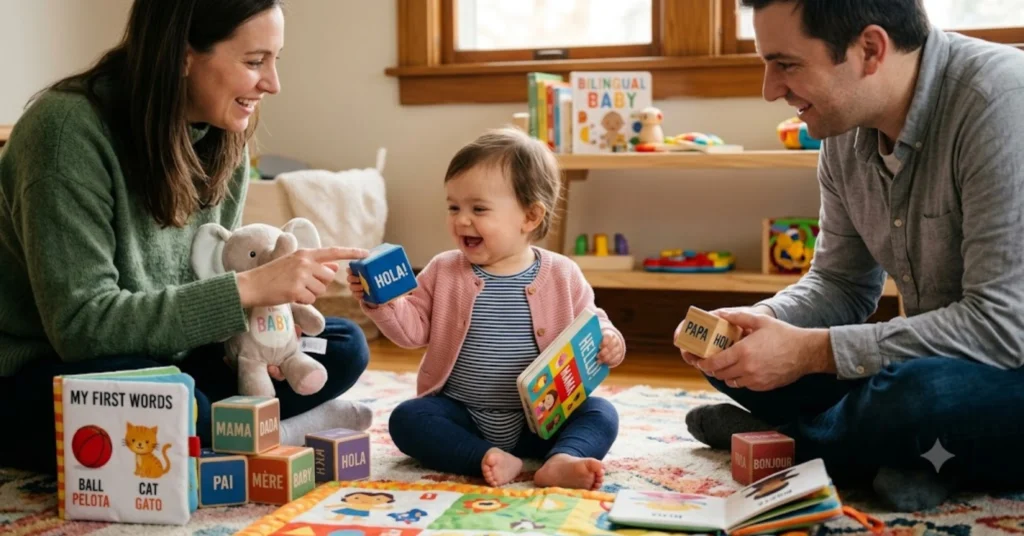
Multilingual households: UAE families commonly raise children in two, three, or four languages simultaneously. According to PMC research on bilingual language development, when total vocabulary across all languages is counted, bilingual children’s rate of vocabulary growth equals or exceeds that of monolingual children.
Apparent delays in a single language are a feature of multilingual development, not a sign of disorder. Assessment should count words in all languages combined, not one language alone. Diverse linguistic environments are a significant factor in how we assess baby development milestones at ESMC.
Month-by-Month Baby Development Milestones: The Complete First-Year Guide
Birth to 1 Month
Physical: Your newborn moves arms and legs in jerky, reflexive motions, turns their head from side to side when placed on their tummy, demonstrates a strong grasp reflex, and startles at loud sounds.
Social and Emotional: Newborns recognize their mother’s voice immediately. They prefer faces over other objects and show brief periods of quiet alertness.
Communication: Crying is the only communication tool at this stage, covering hunger, discomfort, over-stimulation, and tiredness.
Cognitive: Your baby responds to sound and focuses on objects placed 20 to 30 centimeters away — precisely the distance from breast to face during feeding. Early sensory awareness is the first stage of tracking baby development milestones.
UAE context: Skin-to-skin contact is equally important indoors with the AC on. A light muslin wrap keeps your baby warm while preserving the contact. Newborns in UAE are born into a richer language environment than most, with Arabic at the grandparents, a home language, and English in public spaces. This is a developmental advantage. Monitoring these specific baby development milestones provides a clear picture of neurological growth.
1 to 2 Months
Physical: Your baby holds their head up briefly during tummy time, begins to uncurl from the fetal position, and starts to track moving objects with their eyes.
Social and Emotional: The social smile appears in this window and it is one of the most significant milestones of the entire first year. Unlike the reflex smile of the newborn period, it is a direct response to a human face or voice.
Communication: Cooing sounds begin. Different cries for hunger versus discomfort become distinguishable.
Cognitive: Your baby recognizes familiar faces and shows a preference for high-contrast patterns.
Red flag: If your baby is not smiling socially in response to a face or voice by 3 months, come in for a developmental review with our pediatric team at ESMC. Parents should record these baby development milestones to share during their next pediatric visit.
2 to 4 Months
Physical: Head control becomes much steadier. Your baby pushes up on forearms during tummy time, kicks legs purposefully, and brings hands to their mouth repeatedly.
Social and Emotional: Laughter and squealing emerge. Your baby shows whole-body excitement when they see you and begins to respond differently to familiar versus unfamiliar faces.
Communication: Babbling begins, with consonant-vowel combinations starting to form. Your baby turns toward sounds and connects sound with its source.
Cognitive: Objects are followed across the full visual field. Signs of boredom with repetitive stimuli emerge as an early marker of memory formation. Each of these baby development milestones serves as a building block for future physical and cognitive skills.
4 to 6 Months
Physical: Rolling begins, typically tummy to back first, then back to tummy a few weeks later. Your baby sits with support, bears weight on legs when held standing, and reaches for objects with increasing accuracy.
Social and Emotional: Clear preference for primary caregivers develops. Stranger awareness begins. Your baby responds to their own name consistently.
Communication: Babbling becomes more complex and your baby begins to use tone, not just volume, to express different emotional states.
Cognitive: Objects go directly into the mouth as the primary way babies this age explore the world. Your baby is beginning to understand that objects continue to exist briefly even when out of sight.
UAE context: This is the window when many UAE families consider introducing solid foods. The WHO recommendation is exclusive breastfeeding to 6 months, with a solid introduction around 6 months. Our pediatric team at ESMC can guide you on safe weaning introduction, particularly around hydration in UAE’s heat. Understanding the sequence of these baby development milestones helps parents support their infant’s journey.
6 to 9 Months
Physical: Your baby sits independently without support. Crawling begins for many babies, though some skip it entirely and go straight from sitting to pulling to stand. That is entirely normal. Pulling to stand starts. The pincer grasp begins to develop.
Social and Emotional: Separation anxiety begins and is a sign of healthy attachment, not a problem to be solved. Peek-a-boo becomes genuinely engaging. Your baby waves bye-bye and understands that their actions produce consistent responses from caregivers.
Communication: Mama and dada sounds emerge, though not yet used meaningfully. Your baby responds consistently to their own name and begins to understand the word no.
Cognitive: Object permanence develops properly in this window. Your baby will now look for a toy that has been hidden or dropped. Cause and effect is becoming clear. A thorough review of these baby development milestones ensures early detection of any minor delays.
9 to 12 Months
Physical: Your baby pulls to stand and cruises along furniture confidently. Some babies take first independent steps, though walking anywhere between 9 and 18 months is the normal range. The pincer grasp is refined enough to pick up small objects and self-feed finger foods.
Social and Emotional: Affection toward familiar people becomes clear and deliberate. Your baby imitates your actions, shows you objects to share interest, and begins showing strong preferences and recognisable frustration.
Communication: First meaningful words begin for some babies, but comprehension is well ahead of expression. Your baby understands far more than they can say. Pointing to communicate is a key milestone that emerges in this window.
Cognitive: Your baby follows simple one-step instructions, plays imitative games, and looks in the correct place for hidden objects, demonstrating solid object permanence. The mastery of these baby development milestones marks the transition into toddler hood.
Milestone Summary Table
| Age Window | Key Physical | Key Communication | Key Social | Red Flag If Absent By |
|---|---|---|---|---|
| 1 month | Head turns side to side | Cries for needs | Responds to voice | 2 months |
| 2 months | Holds head briefly | Cooing sounds | Social smile | 3 months |
| 4 months | Rolls, reaches | Babbling begins | Laughs, recognises parents | 6 months |
| 6 months | Sits with support | Responds to name | Stranger awareness | 9 months |
| 9 months | Pulls to stand | Mama and dada sounds | Separation anxiety, waves | 12 months |
| 12 months | Cruises furniture | First words emerging | Points to share interest | 15 months |
This summary table provides a high-level overview of essential baby development milestones for the first year of life.
Book Your Baby’s Developmental Check-Up at ESMC Sharjah
UAE-Specific Developmental Considerations
Vitamin D Deficiency
Despite UAE receiving abundant sunshine for most of the year, Vitamin D deficiency is extremely prevalent in UAE children. A PMC study on Vitamin D deficiency in UAE children at a Dubai pediatric hospital found that 39.2 percent of children under 18 had Vitamin D deficiency and a further significant proportion had insufficiency. A broader systematic review of Vitamin D status in the UAE found that in one large Abu Dhabi study of 12,346 participants, 72 percent were Vitamin D deficient despite the country’s year-round sunshine.
Cultural practices of keeping babies covered and limiting outdoor time during the hottest months mean that many UAE infants do not synthesize adequate Vitamin D through sunlight. Vitamin D deficiency affects bone development, muscle tone, and motor milestone achievement directly. All infants in the UAE should receive Vitamin D supplementation from birth. Our pediatric team at ESMC screens for Vitamin D levels as part of routine infant check-ups. Addressing nutritional deficiencies is a key component of supporting healthy baby development milestones.
Iron Deficiency
Iron deficiency is common in UAE babies, particularly those born to mothers with iron deficiency anemia, which is prevalent in the region. Iron is critical for brain development and directly affects cognitive milestone achievement in the first year. ESMC screens for iron levels as part of routine infant care. This early detection is vital for ensuring your infant meets their cognitive baby development milestones without nutritional interference. Iron levels are a critical biological factor in achieving cognitive baby development milestones.
The AC and Tummy Time Issue
Babies in UAE typically spend the majority of their waking hours in air-conditioned environments. Cultural preferences for carrying and holding babies are warm and loving practices, but they can unintentionally reduce the floor time essential for motor development. The American Academy of Pediatrics via HealthyChildren.org recommends a minimum of 30 minutes of daily tummy time from the first week of life, spread across multiple short sessions throughout the day.
Insufficient tummy time is one of the most common and most easily corrected causes of minor motor milestone delays our pediatric team at ESMC sees in UAE infants. Adequate floor time is the foundation for reaching motor-related baby development milestones.
Multilingual Language Development
Mild variance in language milestones is normal and expected in UAE’s multilingual households. According to PMC research on bilingual vocabulary development, when total vocabulary across all languages is measured, bilingual children’s growth equals or exceeds that of monolingual peers. Single-language comparisons under-count bilingual children’s actual language knowledge. Assessment at ESMC accounts for this by asking about vocabulary in all languages spoken at home, not just English. We ensure that linguistic diversity is factored into every assessment of baby development milestones.
Red Flags and Baby Development Milestones: When to Come In for a Developmental Review
The following are not diagnoses. They are signs that it is worth coming to see our paediatric team so we can take a closer look. The CDC emphasises that early intervention is significantly more effective than delayed intervention, and that waiting to see is no longer the recommended approach when a milestone is absent.
By 2 months:
- No social smile in response to a face or voice
- Does not respond to voices or sounds
- Eyes do not track a moving object
By 4 months:
- Does not hold head steady during supported sitting
- Does not reach for objects placed in front of them
- Does not make sounds or vocalise
- Does not smile at familiar people
By 6 months:
- Does not reach for objects
- Does not laugh or squeal
- Does not respond consistently to own name
- No babbling or consonant sounds
By 9 months:
- Does not sit independently
- Does not bear weight on legs when supported
- No babbling at all
- No back-and-forth communication gestures such as waving or pointing
By 12 months:
- No meaningful words in any language, including mama or dada used to refer to a specific person
- Does not point or wave
- Does not look where you point
- Does not search for a hidden object
- Not pulling to stand at all
At any age: loss of previously acquired skills is always a reason for a same-day review, regardless of age or which skill is involved. If your baby could do something and now cannot, come in today. Any regression in established baby development milestones requires an immediate clinical evaluation.
Vaccinations in the First Year
Vaccinations in the first year are not separate from development. They are part of protecting the neurological and physical development that milestones measure. The UAE childhood vaccination schedule is designed to address preventable illnesses that can affect the developing brain and body. ESMC’s pediatric team administers all routine UAE vaccinations and advises on any additional vaccinations recommended for UAE’s climate and community.
If you have concerns about reactions after vaccination, our guide on baby fever after vaccination in UAE covers what is normal, what to watch for, and when to call the clinic. Protecting a child’s health through immunization supports the steady progression of baby development milestones.
When to Come to ESMC’s Pediatrics Department
The Pediatrics Department at ESMC is open seven days a week, 8 AM to 11:30 PM. You do not need to wait until something is clearly wrong to come in for a professional assessment of your baby development milestones.
Come in for:
- Routine developmental check-ups at 6 weeks, 3 months, 6 months, 9 months, and 12 months
- Any concern about a milestone that has not appeared within the ranges in this guide
- Vitamin D and iron screening as part of routine infant care
- Vaccination catch-up if you are new to the UAE or have missed scheduled doses
- Any concern about your baby’s hydration in the heat. Our guide on dehydration signs in children in UAE covers age-specific signs from birth through to school age
- Any time your parental instinct tells you something is not quite right
Our pediatric team at ESMC, led by Dr. Momina Mahmood, is here seven days a week from 8 AM to 11:30 PM. Our department is dedicated to the comprehensive monitoring of baby development milestones for all infants in UAE.
Book Your Baby’s Developmental Check-Up at ESMC Sharjah
Frequently Asked Questions
My baby was born 6 weeks early. How do I calculate their adjusted age for milestones? To calculate adjusted age, subtract the number of weeks your baby was born early from their current age in weeks. If your baby is 16 weeks old and was born 6 weeks early, their adjusted age is 10 weeks. Use this adjusted age for all baby development milestone comparisons for the first two years of life. After 24 months, most premature babies have caught up sufficiently that adjusted age becomes less relevant. Our pediatric team at ESMC applies adjusted age automatically at every check-up for premature infants. This context is vital when interpreting various baby development milestones.
My 9-month-old is not crawling. Should I be worried? Not necessarily. Crawling is not a universal milestone. The updated CDC 2022 guidelines removed crawling as a required milestone, acknowledging that a meaningful proportion of neurologically typical babies never crawl at all. Some bottom-shuffle, some roll from place to place, and some go directly from sitting to pulling to stand. What matters developmentally is that your baby is motivated to move and finding ways to explore their environment independently. If your baby is not mobile in any way by 9 to 10 months, that is worth discussing at ESMC. Our specialists can provide further clarity on these specific baby development milestones during your appointment.
We speak three languages at home. Will this delay my baby’s first words? Multilingual babies may produce their first recognizable words slightly later than single-language norms in each individual language, and this is normal. According to PMC research on bilingual language development, bilingual children’s total rate of vocabulary growth across all languages equals or exceeds that of monolingual children.
Assessment of baby development milestones in UAE’s multilingual families should always count vocabulary in all languages combined. If there are no words in any language by 15 months, that is a reason to come in for a review. Our specialists can provide further clarity on these specific baby development milestones during your appointment.
My baby rolled early. Does that mean they are advanced in other areas too? Rolling early is a positive sign of good muscle tone and motor development, but it does not reliably predict developmental pace in other domains. Some babies roll very early but take a standard amount of time to walk, talk, or develop fine motor skills. Each developmental domain follows its own timeline. Celebrate early milestones, but do not use them to set expectations for everything else or to dismiss a concern in another area. Our specialists can provide further clarity on these specific baby development milestones during your appointment.
How much tummy time does my baby actually need in the UAE heat? The American Academy of Pediatrics recommends a minimum of 30 minutes of tummy time per day from the first week of life, spread across short sessions of 3 to 5 minutes each. In UAE’s heat, tummy time is most comfortable indoors on a firm, flat surface at room temperature. If your baby resists tummy time, try placing them on your chest while you recline slightly. This provides the same neck and core muscle engagement that builds the strength needed for rolling, sitting, and crawling. Our specialists can provide further clarity on these specific baby development milestones during your appointment.
My baby has not said mama or dada meaningfully by 12 months. What should I do? Come in for a developmental review at ESMC. By 12 months, most babies are producing at least one or two words meaningfully, using mama or dada to refer to specific people. If your baby has no meaningful words in any language by 12 months, this warrants a pediatric check.
Early assessment allows early support if needed, and early support is significantly more effective than waiting. Our pediatric team, led by Dr. Momina Mahmood, can assess whether the language picture is part of normal variation or something that would benefit from early intervention. Our specialists can provide further clarity on these specific baby development milestones during your appointment.
What is the difference between a developmental delay and just being a late bloomer? A true developmental delay is when a skill is absent beyond the outer edge of the normal range for that milestone. Within the normal range, even at the later end, a baby is not delayed. The challenge is that parents and even some clinicians sometimes use the term late bloomer as a reason to avoid formal assessment.
The CDC’s 2022 guideline update was specifically designed to reduce the wait-and-see approach. When a milestone is absent at the red flag age, a review is the right next step, not reassurance without assessment. Our specialists can provide further clarity on these specific baby development milestones during your appointment.
My baby lost a skill they had before. Is this normal? Loss of previously acquired skills is not normal and should always be assessed promptly. If your baby was smiling socially and has stopped, was babbling and has gone quiet, or was bearing weight on their legs and no longer does, come in for a same-day review. Developmental regression can have straightforward explanations, but it can also be an early indicator of conditions that respond well to prompt identification. Do not wait to see if it resolves on its own. Our specialists can provide further clarity on these specific baby development milestones during your appointment.
At what age should I be concerned about eye contact? By 6 to 8 weeks, most babies make clear, deliberate eye contact during social interactions. If your baby is consistently avoiding eye contact, not responding to your face, or showing other signs of reduced social engagement alongside this, these signs together are worth discussing with our team. By 9 months, not responding to their name consistently alongside reduced eye contact is a combination that warrants a formal developmental review rather than a wait-and-see approach.
Does screen time affect baby development milestones in the first year? The American Academy of Pediatrics recommends avoiding screen time entirely for babies under 18 months, with the exception of live video calls with family members. Screen time in infancy displaces the face-to-face interaction, language-rich conversation, and physical exploration that are the actual drivers of development in the first year.
In UAE households where extended family abroad connects via video call, that screen time is different in developmental quality because it involves real social interaction and genuine two-way communication. Our specialists can provide further clarity on these specific baby development milestones during your appointment.
Your Baby Is Developing on Their Own Schedule
Your baby is developing in their own time, on their own neurological schedule. Your job in the first year is not to push them toward the next milestone but to give them the environment, the stimulation, and the nutrition that lets their brain do exactly what it was designed to do.
Talk to them constantly. Put them on the floor. Let them mouth safe objects. Respond when they make sounds. Maintain eye contact. Sing to them in every language you know. Those are the inputs that development runs on. Consistency in these daily interactions is what fuels the achievement of baby development milestones.
If you ever wonder whether what you are seeing is normal when tracking baby development milestones in UAE, ask. That is what our team is here for. We would rather see you ten times for peace of mind than have you wait on something that deserved attention earlier.
Book your baby’s developmental check-up at ESMC Sharjah. Al Zahra Street, Maysaloon. Open 8 AM to 11:30 PM daily.
This article is written for general informational purposes by the medical team at Erum Saba Medical Center, Sharjah. It does not replace professional medical advice. If you have concerns about your baby’s development, please consult a qualified pediatrician.