
It happens in seconds. Your 18-month-old is eating lunch, you turn to answer a message, and when you look back they are silent. Not crying. Not coughing. Silent. Their faces are changing color. You pick them up and your mind goes completely blank. Staying alert at every meal is a fundamental rule of child safety.
Choking in young children in UAE is one of the most common pediatric emergencies our team at Erum Saba Medical Center sees. It is also one of the most survivable, but only if the person present knows exactly what to do in the first 60 seconds. Most parents in the UAE have never been trained in infant or child first aid. This guide changes that. Read it, save it, and share it with every caregiver in your child’s life. Empowering yourself with knowledge is the best way to ensure long-term child safety.
Table of Contents
Why Young Children Choke More Than Older Children and Adults
Children under 4 are at the highest risk of choking for three specific reasons that are entirely developmental and not about negligence. Understanding these physical limitations is key to maintaining child safety.
First, their airway diameter is significantly narrower than an adult’s. An object that an adult would cough out easily can completely obstruct a small child’s airway. The trachea of a one-year-old is approximately the width of a drinking straw. Ensuring food is properly textured supports consistent child safety.
Second, their molar teeth do not fully emerge until around age 2 to 3. Before molars are present, children cannot properly grind food. They swallow pieces that are far larger than they appear to manage, even when they seem to be chewing confidently. Environmental management is a primary pillar of child safety.
Third, children in this age group explore the world primarily through their mouths. Every small object within reach is a potential airway hazard. This is not curiosity that can be trained away. It is a developmental stage that must be managed environmentally. Data-driven awareness helps families prioritize child safety.
According to global data on child injury prevention from organizations like the WHO, choking and suffocation are among the leading causes of unintentional injury death in children under five globally, with the highest risk concentrated in the 1 to 3 year age group.
Prioritizing Child Safety With Highest Risk Foods In A UAE Household

This is not just a generic international list. In UAE households, local food culture creates specific risks that parents must actively manage every single day. Adapting to local culinary habits is essential for child safety.
- Dates: These are the single highest-risk food in UAE households for young children. They are consumed daily, left accessible on coffee tables during Ramadan and Eid gatherings, given to babies as a traditional soothing food, and offered whole to toddlers who cannot adequately chew them. The combination of dense, sticky flesh and a hard pit makes them one of the most dangerous choking hazards in this specific community. Dates must always be stoned and mashed or cut into very small pieces for children under 4. Careful preparation of traditional staples is vital for child safety.
- Grapes and Cherry Tomatoes: Round, firm, and exactly the size of a small child’s airway. These must always be cut lengthwise into quarters, not halved, before being given to any child under 5. Always quartering round fruits significantly improves child safety.
- Nuts and Seeds: Extremely common in South Asian and Arab cooking. Cashews, almonds, peanuts, pine nuts, and sesame seeds all present significant choking risk in whole or large-piece form. Nut butters spread thinly are safe. Whole nuts are not appropriate before age 4. Choosing age-appropriate textures is necessary for child safety.
- Rice Cakes and Dry Biscuits: A common snack given to babies learning to self-feed. When a large piece breaks off, it can form a sticky mass that adheres to the airway wall. Supervise all solid snack eating in this age group without exception. Direct supervision during snack time is a requirement for child safety.
- Meat on the Bone: Very common at Eid gatherings where children are given pieces of meat on small bones. Bone fragments are a serious choking hazard. Always remove all bone and cartilage before giving meat to children under 5.
- Hard Candies, Toffees, and Gummy Sweets: Particularly relevant during Eid when children receive sweets from relatives across multiple households. Hard sweets must not be given to children under 4. Gummy sweets are safer but should be supervised.
- Peas and Corn Kernels: Small, round, and firm. Cut or mash before serving to children under 2.
- Chewing Gum: Never appropriate for children under 4. If swallowed, it can adhere to the airway and does not dissolve like food.
| Food | Risk Level | Safe Preparation |
| Dates | Very High | Stone removed, mashed or cut very small |
| Grapes | Very High | Cut lengthwise into quarters |
| Whole nuts | Very High | Avoid completely under age 4 |
| Meat on bone | Very High | Remove all bone before serving |
| Hard candy | Very High | Avoid completely under age 4 |
| Rice cakes | Moderate | Supervise closely, small pieces only |
| Corn and peas | Moderate | Mash or cut under age 2 |
| Gummy sweets | Moderate | Supervise under age 4 |
The Highest Risk Objects in a UAE Home
Non-food choking hazards are common across modern UAE apartments and villas, often left out on counters or low tables. Daily room sweeps are a practical step toward child safety.
- Coins: UAE coins including 25 fils and 50 fils pieces are exactly the right size to lodge in a small child’s airway. Keep all coins in closed containers above child reach at all times. Keeping small change out of reach is an easy win for child safety.
- Button Batteries: Found in remote controls, small toys, key fobs, watches, and decorative items. Button batteries are not only a choking hazard but cause severe chemical burns to the oesophagus within 2 hours if swallowed. Securing lithium batteries is a critical priority for child safety.
- Toy Components and Balloon Fragments: Small toy parts, detached eyes from stuffed animals, and uninflated or burst balloon pieces are among the leading non-food choking hazards in this age group. The inside of a balloon fragment creates an airtight seal against the airway wall. Sorting toys by age group is a proactive measure for child safety.
- Hair Ties and Rubber Bands: Left on coffee tables and accessible surfaces throughout UAE homes. Small enough to swallow easily and elasticated enough to create a difficult airway obstruction.
- Bottle Caps: Water bottle and juice bottle caps are frequently accessible in UAE homes where bottled water is standard. Keep caps out of reach.
EMERGENCY CALLOUT: Button Battery Swallowing
If you suspect your child has swallowed a button battery, go to the emergency department immediately. Do not wait for symptoms. Do not give food or water. Chemical burns from button batteries begin within 2 hours and can cause life-threatening damage to the oesophagus. Call 998 immediately.
How to Tell if Your Child is Choking: The Critical Distinction
This distinction is what determines whether a parent intervenes physically or steps back.
Effective Coughing (Do Not Intervene Physically)
If your child is coughing loudly, crying, or making any vocal sound, their airway is partially open and they are moving air. Encourage them to keep coughing. Do not slap their back or put your fingers in their mouth when they are coughing effectively as this can push the obstruction further down or introduce a second hazard. Knowing when to observe rather than touch is crucial for child safety.
Complete or Severe Obstruction (Intervene Immediately)
The child cannot cough, cry, or make any sound. They may be making a high-pitched wheeze or complete silence while visibly struggling to breathe. Their face is becoming red, then blue or pale. They may clutch their throat. They cannot speak. This is a complete or near-complete airway obstruction and requires immediate physical intervention. Acting swiftly during a total blockage is life-saving child safety.
CRITICAL FACT: Silence is the Signal
A choking child who cannot cry or cough needs you to act in the next 60 seconds. Call 998 and begin first aid immediately. Recognizing the danger of silence is a core tenet of child safety.
Critical Child Safety Protocols: First Aid Steps For The First 60 Seconds
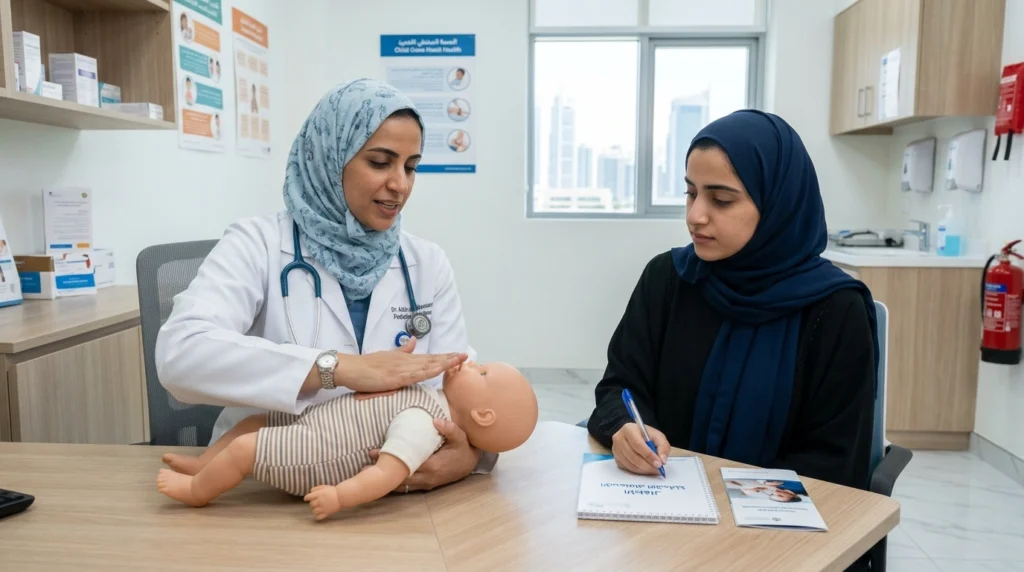
Follow these protocol steps precisely based on your child’s age group for child safety.
For Babies Under 1 Year
1.Call 998:Immediate Action.
Call 998 or ask someone nearby to call while you begin first aid. Do not stop to call 998 yourself if you are alone, begin first aid first and call between steps if possible. Activating emergency services immediately is the first step in child safety.
2.Position the Baby:Face-Down.
Hold your baby face-down along your forearm, supporting their head. Their head must be positioned lower than their chest.
3.Deliver 5 Back Blows: Heel of Hand.
Give 5 firm back blows between the shoulder blades using the heel of your hand. Each blow should be a separate, deliberate strike, not a continuous rub.
4.Flip and Position: Face-Up.
Turn the baby face-up along your other forearm, keeping the head lower than the chest.
5.Deliver 5 Chest Thrusts: Two Fingers.
Give 5 chest thrusts. Place 2 fingers on the centre of the chest just below the nipple line. Push down approximately one third of the chest depth. Each thrust is a separate, deliberate movement.
6.Check the Mouth: Visual Inspection Only.
Look in the mouth. If you can clearly see an object, remove it with one finger. Never perform a blind finger sweep as this can push the object further in.
7.Repeat Cycle: Continuous Care.
Repeat the cycle of 5 back blows and 5 chest thrusts until the object is dislodged or emergency services arrive. If the baby becomes unconscious, begin infant CPR immediately. Persistence in first aid techniques is mandatory for child safety.
WARNING
Never perform abdominal thrusts on a baby under 1 year. Use chest thrusts only. Abdominal thrusts on an infant can cause serious internal injury.
For Children Over 1 Year
1.Call 998: Immediate Action.
Call 998 or ask someone to call while you begin first aid. Ensuring professional help is on the way is essential for child safety.
2.Deliver 5 Back Blows: Leaning Forward.
Position the child leaning forward. Use the heel of your hand to deliver 5 firm blows between the shoulder blades. Each blow is a separate strike.
3.Deliver 5 Abdominal Thrusts: Heimlich Maneuver.
Stand or kneel behind the child. Make a fist with one hand and place it just above the navel and below the ribcage. Cover your fist with your other hand and pull sharply inward and upward. Repeat 5 times.
4.Check the Mouth: Visual Inspection Only.
Check the mouth. Remove any visible object. Do not perform a blind finger sweep.
5.Repeat Cycle: Continuous Care.
Repeat the cycle of 5 back blows and 5 abdominal thrusts until the object is cleared or help arrives. If the child becomes unconscious, begin child CPR immediately.
If your child appears to recover after a choking episode but you used back blows or abdominal thrusts, bring them to the Pediatrics Department at ESMC for a check-up. Internal bruising and object displacement need to be assessed even when the child seems fine for your child safety.
What NOT to Do: The Mistakes That Make Choking Worse
- Do not perform a blind finger sweep: Putting your fingers in a child’s mouth without being able to see an object can push it further down the airway and convert a partial obstruction into a complete one. Avoiding risky maneuvers protects the integrity of child safety.
- Do not hold a baby upside down and shake them: This was traditional advice in some communities and is completely incorrect. It does not help dislodge an airway obstruction and risks severe neck injury.
- Do not give a choking child water: Water does not help dislodge a solid object from the airway and can cause aspiration in a partially obstructed airway.
- Do not wait to see if it resolves: Complete or near-complete airway obstruction is a minutes-level emergency. Every minute without oxygen causes brain damage. Do not wait.
- Do not leave the child alone: Even to retrieve a phone, you should not leave them. Take the child with you or shout for help while staying with the child. Maintaining physical proximity during an emergency is key to child safety.
UAE-Specific Risks and Scenarios UAE Parents Must Know

- Eid gatherings and unsupervised access to food: During Eid, large amounts of dates, sweets, nuts, and meat on bone are accessible at low table height across multiple households. Children move between rooms and between adults’ supervision. No single adult is watching any single child continuously. Designate one adult per gathering specifically responsible for food safety around young children. Designating a safety monitor during holidays promotes better child safety.
- Maids and caregivers without first aid training: Many UAE families have live-in or part-time caregivers who spend significant hours alone with young children. These caregivers may never have received any pediatric first aid training. Share this guide with every caregiver in your child’s life. Providing training to all household staff is a smart investment in child safety.
- Traditional foods given to babies: Some traditional practices in South Asian and Arab communities involve giving babies small pieces of food, dates, or honey-dipped items as part of cultural rituals. Any solid food given to a baby before 6 months presents a choking risk regardless of cultural significance. Ensure you are tracking baby development milestones UAE to know when they are truly ready for solids.
- Unsupervised play with older siblings’ toys: Older siblings’ toys routinely contain small parts that are appropriate for their age but dangerous for a baby or toddler in the same household. LEGO bricks, marbles, small car wheels, and action figure accessories are extremely common in UAE households where siblings are spread across multiple age groups. Keep older children’s toys in a room the baby cannot access.
Prevention Checklist: What to Do This Week
- Get down to your child’s level and walk through every room identifying objects within reach that are smaller than a 50 fils coin. Viewing the world from a toddler’s perspective enhances child safety.
- Remove all coins from accessible surfaces and store in a closed container above child height.
- Check all remote controls and small electronics for secure battery compartments.
- Cut all grapes, cherry tomatoes, and similar round foods into lengthwise quarters before every meal.
- Stone all dates before giving them to any child under 4.
- Never leave a child under 4 unsupervised while eating.
- Share this guide with every caregiver, grandparent, and household member who spends time with your child.
- Save 998 in your phone favourites and know your nearest emergency department.
- Teach older siblings in the household that the baby cannot have their small toys. Involving the whole family creates a culture of child safety.
When to Come to ESMC
Come to Erum Saba Medical Center for a same-day assessment with Dr. Momina Mahmood if:
- Your child experienced a choking episode and you performed back blows or abdominal thrusts, even if they recovered and appeared well. Internal bruising and displaced objects need clinical assessment. Seeking medical confirmation after an incident is important for child safety.
- Your child swallowed an object and you are unsure whether it is in the airway or the digestive tract.
- Your child is coughing persistently after a meal or has developed a wheeze that was not present before.
- You notice any lingering dehydration signs in children in UAE or other issues following an illness or choking scare.
For any life-threatening emergency, call 998 first for your child safety. Come to ESMC for follow-up assessment once the child is stabilized.
Book a pediatric appointment at ESMC Sharjah
Frequently Asked Questions
What is the difference between gagging and choking a baby?
Gagging is a normal, loud defense mechanism where your baby coughs or splutters to push food forward, meaning their airway is clear. Choking is silent, meaning the airway is fully or mostly blocked, and the baby cannot cry, cough, or breathe. You must never intervene during gagging, but you must act immediately if they are choking.
My child choked but coughed the object out on their own. Do I still need to see a doctor?
Yes, it is highly recommended to have them evaluated by a physician. Small food fragments can sometimes be aspirated into the lungs, leading to infections or breathing issues later on. A quick examination at ESMC ensures their lungs are completely clear and no hidden damage occurred.
At what age can children eat whole grapes, nuts, and similar foods safely?
Children should avoid whole nuts and uncut round foods until at least age 4 or 5. By this time, their molars are fully developed, and their chewing coordination is mature enough to grind tough textures. Until then, always quarter round foods and chop or grind nuts safely.
What should I do if my child swallows a button battery?
This is a critical emergency that requires you to go to the nearest emergency room immediately or call 998. Do not try to induce vomiting and do not give them anything to eat or drink. The battery can cause life-threatening internal chemical burns within just 2 hours of ingestion.
Is it safe to start baby-led weaning in UAE or does it increase choking risk?
Baby-led weaning is safe provided you follow strict preparation rules and wait until your baby shows all signs of developmental readiness. Studies show it does not increase choking risk compared to spoon-feeding if foods are soft and correctly shaped. However, you must still supervise every meal and avoid high-risk items like whole dates or nuts.
My child choked and I performed back blows and abdominal thrusts. They are fine now. Do I need to come in?
Yes, any child who has received physical first aid interventions like abdominal thrusts or firm back blows needs a medical evaluation. These physical maneuvers can cause internal bruising or minor trauma to delicate organs that might not be visible externally. Our team can check for any underlying injuries to ensure your child is truly safe.
How do I know if something is still lodged in my child’s airway after a choking episode?
Signs include a persistent cough, unexplained wheezing, stridor (a high-pitched whistling sound when breathing), or difficulty speaking and swallowing. Sometimes an object shifts but remains partially stuck, which can cause serious lung complications if left unaddressed. If you notice any of these signs, seek medical attention immediately.
Can I learn infant and child first aid at ESMC Sharjah?
Our pediatric department regularly offers guidance and resource materials on critical first aid protocols for parents and caregivers. Knowing how to handle choking, basic CPR, and other issues like heatstroke in children in UAE can make all the difference. Contact our front desk to learn about upcoming parent workshops.
My maid looks after my child while I am at work. How do I make sure she knows what to do?
You should print out the visual, numbered first aid steps from this guide and place them prominently on your refrigerator. Sit down with her to physically review the steps, ensuring she understands the emergency number is 998. Enrolling her in a certified local pediatric first aid course is the best way to gain peace of mind.
My baby puts everything in their mouth. At what age does this stop and how do I manage it safely?
Mouthing objects usually peaks around 6 to 12 months and begins to decline around age 2 as their verbal and exploratory skills develop. You cannot train a baby out of this behavior because it is a vital developmental stage for learning. The only safe management strategy is strict environmental control, keeping your floors and low tables completely free of tiny hazards. Patience and a clear floor are the best tools for child safety.
You have now read everything you need to know to act correctly in the first 60 seconds of a choking emergency for your child safety. The most important thing you can do now is not close this tab and forget it. Save it. Share it with your spouse, your parents, your maid, and your child’s nursery. If you have never attended a pediatric first aid course, consider this your sign to look into one for your child safety. The 60 seconds you practice today could be the 60 seconds that matter most.
Book a pediatric consultation or inquire about first aid guidance at ESMC Sharjah
Al Zahra Street, Maysaloon. Open 8AM to 11:30PM daily.