Asthma in children in Sharjah becomes significantly harder to manage every time the UAE summer arrives, and the reason is not simply the heat. It is 2am. Your seven-year-old is coughing again. Not the barking cough of croup, and not the wet cough of a standard school cold. It is that dry, persistent, slightly wheezy cough that comes in waves and will not settle.
They had the same exhausting cough through April. You saw it last summer too. You have started wondering whether the inhaler from the GP in December is still the right one. More than anything, you wonder why the UAE environment seems to make it so much worse than it was before you moved here.
You are right to question it. The UAE summer is one of the most hostile environments in the world for a child with sensitive airways. Most international asthma management guidelines were written for cooler, Western climates. They do not account for a place where outdoor temperatures reach 45 degrees Celsius with 80 percent humidity while indoor air is bone dry from constant air conditioning. This guide was written specifically for Sharjah parents navigating these exact conditions.
Table of Contents
Why Asthma and Allergies Are So Prevalent in the UAE
Many parents wonder whether their child developed breathing difficulties because of where they live. It is a legitimate concern. The medical evidence confirms it: children in the Gulf region experience significantly higher rates of respiratory conditions than global averages.
The World Health Organization places global childhood asthma prevalence at approximately 9 percent. A large multicenter cross-sectional study published in PMC involving 3,436 children from Dubai and the Northern Emirates, including Sharjah, found asthma prevalence of 11.9 percent in 6 to 7 year olds and 9.8 percent in 13 to 14 year olds. The ISAAC study in UAE schools previously reported physician-diagnosed asthma of 13 percent in 3,200 children aged 6 to 13 across all seven Emirates.
The same PMC multicenter study found that the Northern Emirates, including Sharjah, showed particularly high prevalence of allergic rhinitis and atopic dermatitis in school-age children, confirming that the Sharjah environment presents a specific respiratory risk profile.
Prolonged indoor living reduces microbial diversity. Because of the intense heat, children in the UAE spend a disproportionate amount of time in sealed, air-conditioned spaces. According to the hygiene hypothesis, well-documented in clinical literature, this reduces early childhood exposure to the diverse microbial environments that train the immune system. The result is higher rates of allergic sensitisation.
UAE desert dust is not ordinary household dust. It contains a complex mix of fine mineral particles, biological allergens, and microscopic pollutants from rapid construction and heavy traffic. According to PMC research on desert dust and respiratory health, PM2.5 particles from desert dust activate immune cells in the airways, leading to inflammation, oxidative stress, and impaired lung function. These particles are small enough to bypass nasal filtration and penetrate deep into a child’s small airways.
Genetic predisposition in South Asian populations. Research consistently shows a stronger genetic tendency toward atopic diseases in South Asian populations, which make up a significant proportion of Sharjah’s expatriate community. If a parent has a history of eczema, hay fever, or asthma, their child’s risk of reacting to local triggers is meaningfully elevated.
Why UAE Summer Specifically Makes Asthma and Allergies Worse
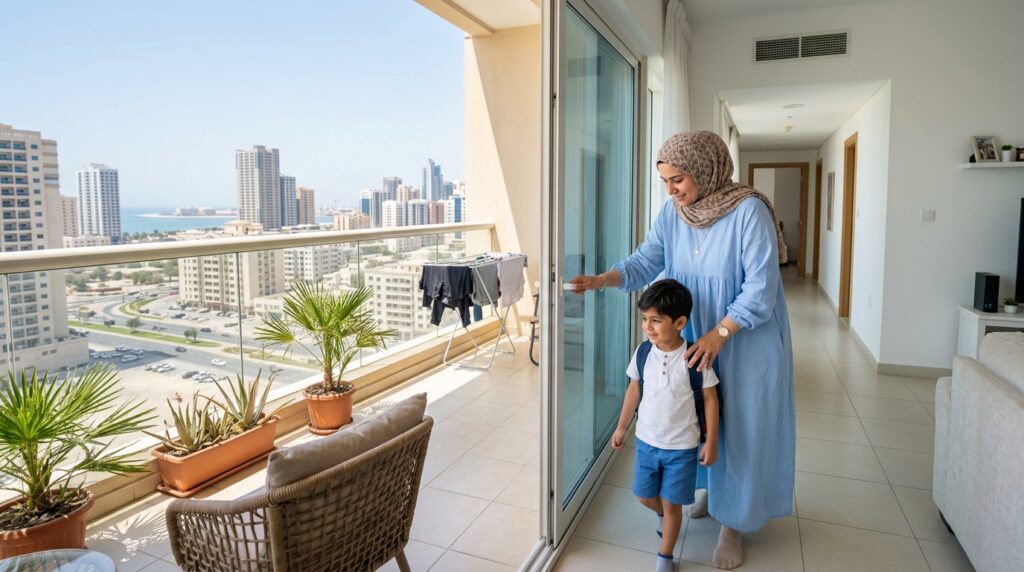
The arrival of June brings specific climate changes that directly irritate hyperreactive airways. Understanding each trigger helps you predict and prevent flare-ups.
Heat and Hot Air Inhalation
Breathing air above 35 degrees Celsius causes reflexive airway constriction in children with sensitive lungs. Even brief exposure to peak daytime heat during a short walk to the car can trigger bronchospasm. The high relative humidity outdoors does not protect against this: the absolute moisture content of superheated air interacts with the bronchial lining in ways that cooler, moister air does not.
Dust Storms and the Haboob
Sharjah regularly experiences intense dust storms from late spring through September. During and immediately after a dust event, concentrations of airborne PM2.5 rise to clinically significant levels. A PMC review on PM2.5 and children’s lung function found that short-term PM2.5 exposure produces measurable reductions in schoolchildren’s lung function, with the association strongest in children with existing respiratory sensitivity. Parents commonly notice coughing and wheezing spikes in the 24 to 48 hours following a visible dust storm.
Ground-Level Ozone Pollution
Intense summer sunlight interacts with local traffic and industrial emissions to create ground-level ozone, a powerful respiratory irritant. Children are significantly more vulnerable than adults because they breathe more rapidly and inhale more air relative to their body weight during the same period of outdoor exposure.
AC Systems and Indoor Air Quality
When cooling systems run continuously without regular deep servicing, they accumulate moisture, dust mites, and mould species common in humid Gulf environments. Every time the fan runs, it circulates these allergens through the home. Additionally, continuous AC removes moisture from indoor air, dropping relative humidity to 20 to 30 percent, well below the 40 to 50 percent range that supports healthy mucosal clearance in the airways.
The AC-to-Outdoor Temperature Shock
Moving repeatedly between a 22-degree Celsius interior and 44-degree Celsius outdoor heat forces the smooth muscle surrounding the airways to contract suddenly. UAE children experience this thermal shock multiple times daily during school holidays, weekend activities, and family outings, creating a cumulative airway stress that children in more stable climates never face.
Swimming Pool Chloramines
Swimming is the most popular summer activity in Sharjah, but it carries hidden respiratory risks. When chlorine interacts with organic matter in pool water, it produces chloramine gases that sit just above the water surface. Indoor pools are particularly problematic because the gases concentrate in enclosed air. Prolonged chloramine exposure is a well-documented asthma trigger in children who swim regularly.
Recognising Asthma: Is It Asthma or Just Frequent Colds?
Childhood asthma remains significantly underdiagnosed throughout the Emirates. Many parents mistake recurrent wheezing and chronic coughing for a sequence of separate infections when the pattern is actually a single, uncontrolled inflammatory condition.
The pattern matters more than any individual episode. A child who develops a dry cough every month is not catching a new virus each time. If the coughing consistently worsens between 2am and 4am, or if a doctor has repeatedly diagnosed chest infections, asthma is clinically probable.
Triggers distinguish asthma from infection. If coughing starts during active play, after loud laughter, or when sitting under an AC vent, the airways are showing hyperreactivity rather than responding to an infection.
Classic asthma symptoms in children include:
- A distinct whistling sound when breathing out, known clinically as a wheeze
- Older children describing chest tightness or difficulty drawing a full breath
- Rapid recovery when a reliever inhaler such as Salbutamol is given
The atopic triad is a strong diagnostic signal. Medical professionals look for the deep clinical overlap between asthma, eczema, and allergic rhinitis. If your child has dry, itchy skin patches and frequent sneezing alongside respiratory symptoms, their risk for allergic asthma is very high. Managing all three conditions simultaneously consistently produces better outcomes than treating each in isolation.
Use this comparison to help you distinguish between the two conditions:
| Feature | Viral Cold | Asthma Episode |
|---|---|---|
| Duration | Usually 7 to 10 days | Can persist for weeks |
| Fever | Common | Rare |
| Time of day | No specific pattern | Often worse at night or early morning |
| Cough character | Wet, productive | Dry, persistent, wheezy |
| Triggers | Viral exposure | Exercise, cold air, dust, AC |
| Response to inhaler | No effect | Rapid improvement |
| Pattern | Separate episodes | Recurring in same child |
Important: If your child has this recurring pattern of coughing without fever, continuing to treat with over-the-counter cough syrups can delay effective anti-inflammatory care by months or years. Book a dedicated paediatric assessment at ESMC.
Home Management: What Sharjah Parents Can Do Right Now
Maintain preventer medication compliance. According to the Global Initiative for Asthma (GINA) guidelines, preventer medications must be taken every day to keep underlying airway inflammation under control. Stopping because the child appears well allows invisible inflammation to rebuild, leading to a severe summer flare. The preventer is working precisely when the child seems fine.
Accelerate AC filter maintenance. Standard quarterly servicing is insufficient during the UAE summer. Wash or replace home AC filters every 4 to 6 weeks from May through October. Clogged filters accumulate mould and fine dust which is then circulated through the bedroom every time the system runs.
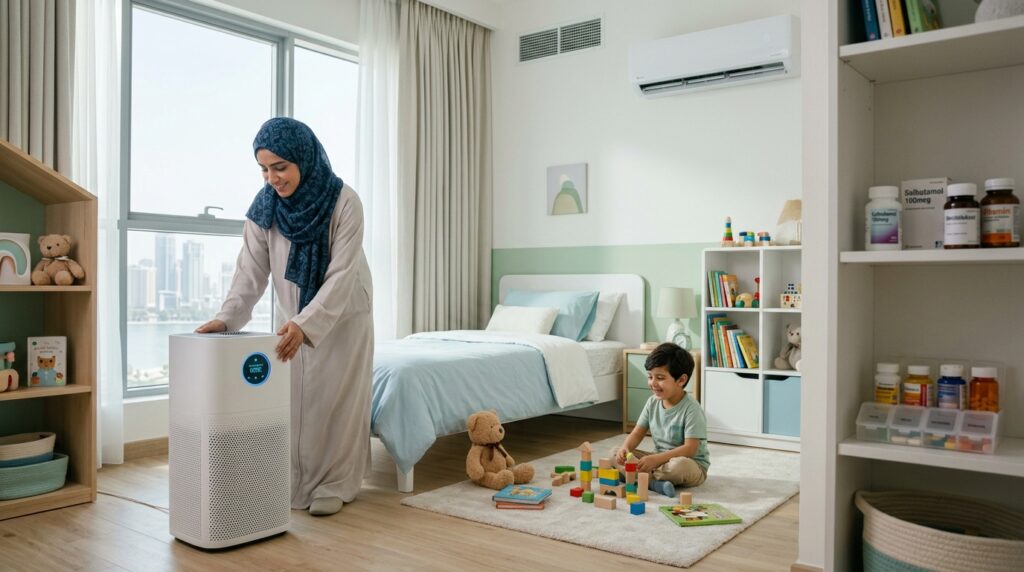
Place a HEPA air purifier in the bedroom. Because children spend 8 to 10 consecutive hours in their bedroom each night, keeping this specific zone free of allergens provides measurable respiratory relief. A HEPA-grade purifier is the most impactful single environmental modification for an asthmatic child in a UAE household.
Balance indoor humidity. Use a cool-mist humidifier in the bedroom to keep humidity closer to the 40 to 50 percent range. This prevents the desiccation of the airway mucosa that impairs natural particle clearance and worsens nocturnal symptoms.
Execute a strict dust storm protocol. When a haboob is forecast or visible, close all windows and external doors immediately. Apply temporary weatherstripping to older window frames. Switch split AC units to internal recirculation mode to prevent outdoor dust from entering the home. Maintain this protocol for at least 24 hours after the storm passes.
Choose outdoor pools over indoor pools. Chloramine gases disperse in open air. Ensure your child showers immediately after every swimming session. Monitor for post-swim coughing and report this pattern to your paediatrician.
Keep a written Asthma Action Plan. The American Academy of Pediatrics recommends that every child with diagnosed asthma has a written plan specifying exactly what to do at each symptom level, what medications to give, and when to seek emergency care. Keep a printed copy on your refrigerator and share a digital copy with your child’s school nurse or caregiver.
Book a Paediatric Asthma Assessment at ESMC Sharjah
When to Come to ESMC: The Red Flags
Come immediately if:
Your child’s breathing is visibly laboured with the skin pulling inward between the ribs or at the base of the throat with each breath. This is called accessory muscle use and indicates significant respiratory distress requiring urgent clinical assessment.
Your child’s reliever inhaler provides no visible improvement within 10 to 15 minutes, or the relief lasts less than 4 hours before symptoms return. This means their airways are severely restricted and their current management is inadequate.
Emergency: If your child’s lips, tongue, or fingernails appear pale, grey, or blue, this indicates a dangerous drop in blood oxygen. Call 998 immediately. Do not drive to the clinic yourself.
Come to ESMC for a planned review if:
You are reaching for the reliever inhaler more than twice a week. Your child is waking with coughing more than twice a month. School or nursery attendance has declined due to respiratory symptoms. You have never had a formal asthma diagnosis confirmed or a written Asthma Action Plan prepared. Your child was diagnosed with asthma in another country and has never had a UAE-specific assessment.
What ESMC’s Paediatric Team Can Do

At Erum Saba Medical Center, our approach to childhood respiratory conditions focuses on long-term control rather than reactive treatment of acute attacks. Our paediatric team, led by Dr. Momina Mahmood, provides:
A structured assessment of your child’s current asthma control using validated clinical tools. Review and optimisation of the current inhaler regimen, including checking whether the device type and spacer are appropriate for your child’s age. Identification of uncontrolled allergic triggers and assessment of whether allergy testing is appropriate. Evaluation of associated conditions including allergic rhinitis and eczema to ensure the entire atopic picture is managed together. A personalised written Asthma Action Plan for the school and home environment. UAE-specific environmental management guidance tailored to your home, your location, and your child’s lifestyle.
Many children presenting to ESMC with apparent recurrent respiratory infections are actually experiencing undiagnosed or uncontrolled asthma. Our guide on recurrent coughs, colds, and ear infections in Sharjah children explains when a pattern of respiratory illness crosses the threshold from infection to inflammation.
Allergy Testing in Children: What It Involves and When It Is Needed
Allergy testing is recommended when a child has multiple atopic symptoms, when standard asthma therapies do not produce adequate control, or when a specific environmental or food trigger is suspected but not yet confirmed.
Skin prick testing (SPT) is the most common first-line method. Small drops of purified allergen extracts are placed on the forearm and a sterile lancet makes a tiny, painless scratch through each drop. Results are visible within 20 minutes as small, localised reactions if an allergy is present. It is not painful in the way an injection is, but children should be prepared for the sensation in advance.
Specific IgE blood tests are an alternative when SPT cannot be performed, such as in a child with widespread eczema or one who cannot safely stop antihistamines before testing.
Testing in Sharjah focuses on UAE-relevant allergens: house dust mites, indoor mould species from humid AC ducts, cockroach allergens, camel dander, Bermuda grass pollen, and date palm pollen. Identifying specific triggers allows precise environmental modifications that support medical treatment.
Frequently Asked Questions
My child coughs every night but has no fever. Could this be asthma in children in Sharjah?
Yes, and this is actually one of the most classic presentations of childhood asthma. When a child sleeps, natural cortisol levels drop and airways tend to cool and narrow slightly. Breathing dry, cold air from a bedroom AC unit during this period often triggers persistent coughing fits between midnight and the early morning hours. If this pattern is recurring across weeks or months without fever or other infection signs, a paediatric assessment for asthma is strongly recommended.
What is the difference between a reliever and a preventer inhaler?
A reliever inhaler, usually blue, works quickly by relaxing the tight muscles around the airways during a sudden coughing or wheezing episode. A preventer inhaler, typically brown, orange, or purple, contains a low-dose anti-inflammatory medicine that must be taken every single day. The NHS explains that the preventer builds up a protective layer over time to reduce airway swelling from the inside, stopping attacks before they start rather than treating them after they begin.
Can a child grow out of asthma?
Many children who experience mild wheezing during toddler years see their symptoms improve as their lungs mature. However, children with a strong family history of allergies, or those with concurrent eczema and allergic rhinitis, frequently have symptoms that persist into adulthood. Rather than waiting to see if a child outgrows the condition, controlling the inflammation now prevents long-term airway remodelling that can make the condition harder to manage in later years.
Is it safe for my child with asthma to swim in UAE pools?
Swimming is generally excellent exercise for lung development, but pool selection matters significantly for asthma in children in Sharjah. Enclosed indoor pools trap chloramine gases near the water surface, which are potent airway irritants. Outdoor pools where air circulates freely are a significantly better choice during summer. Discuss pre-swim reliever use with your ESMC paediatrician and ensure your child showers with fresh water immediately after every session.
My child uses a reliever inhaler almost every day. Is this normal?
No. Needing a reliever inhaler more than twice a week is a clear clinical sign that asthma is not under control. Frequent rescue inhaler use treats temporary bronchospasms while leaving the underlying airway inflammation completely unaddressed. According to GINA guidelines, this pattern is a direct indicator that daily preventer therapy needs to be started or adjusted. A paediatric review at ESMC should be scheduled promptly.
How do I know if my child needs allergy testing rather than just asthma treatment?
Allergy testing is particularly beneficial if your child shows the atopic triad of asthma alongside chronic nasal congestion or itchy skin, if symptoms spike during specific activities like changing bed linen or after dust storms, or if standard treatment is not producing adequate symptom control. Identifying the specific triggers allows targeted environmental modifications that meaningfully improve the effectiveness of any medication your child is already taking.
Can asthma cause my child to fail at sports or PE at school?
Uncontrolled asthma can make physical activity difficult and lead children to avoid exercise out of fear of breathlessness. However, when asthma is managed correctly with a daily preventer routine and a clear Asthma Action Plan, your child should be able to participate in all school sports and physical activities alongside their peers. Many elite athletes manage asthma successfully. The goal of treatment at ESMC is to make asthma invisible in your child’s daily life, not to limit it.
Should I keep my child indoors all summer to protect their breathing?
While keeping your child indoors during severe dust storms or extreme midday heat is necessary, total summer isolation is neither practical nor healthy for a child’s physical or mental wellbeing. Indoor air itself can contain significant allergen loads from AC systems, dust mites, and mould. The goal of effective paediatric asthma management at ESMC is to optimise your child’s medical plan and their indoor environment so they can safely enjoy normal summer activities without restriction.
My child was diagnosed with asthma in Pakistan. Do I need a new assessment in the UAE?
Yes, an updated assessment is strongly recommended. The environmental triggers in the UAE differ significantly from those in South Asia. A child who reacted to specific plant pollens in Pakistan will now face constant exposure to AC systems, UAE desert dust particles, coastal humidity patterns, and pool chloramines. A UAE-specific paediatric review at ESMC ensures their management plan accounts for these regional factors rather than relying on a plan designed for a completely different environment.
What is an Asthma Action Plan and how do I get one from ESMC?
An Asthma Action Plan is a clear written guide created by your doctor that divides your child’s respiratory health into green, yellow, and red zones. It specifies exactly what daily medications to give when they are well, what adjustments to make if a mild cough develops, and at what point to seek emergency care. You can request a personalised Asthma Action Plan for your child’s school and home during a consultation with Dr. Momina Mahmood at ESMC Sharjah.
The Bottom Line
Managing asthma in children in Sharjah during UAE summer is genuinely challenging. The combination of outdoor heat, seasonal dust storms, swimming pool chloramines, and continuous indoor air conditioning creates a respiratory environment that standard international guidelines simply do not prepare parents for.
With the right daily medication, targeted improvements to your home’s air quality, and a paediatric team who understands what the Sharjah environment specifically does to small airways, your child can have an active and comfortable summer. You do not have to spend the hottest months counting inhaler puffs and waiting for the next attack.
Dr. Momina Mahmood and our paediatric team at ESMC are here to build a practical, evidence-based management plan for your child’s specific respiratory profile. If you are also concerned about your child’s general health heading into the new season, our school health checklist for Sharjah parents covers everything to review before September, including vaccination catch-up and developmental checks.
ESMC Sharjah. Al Zahra Street, Maysaloon. Open 8AM to 11:30PM daily.
Book a Paediatric Asthma Assessment Now
This article is written for general informational purposes by the medical team at Erum Saba Medical Center, Sharjah. It does not replace professional medical advice. If you are concerned about your child’s breathing or respiratory health, please consult a qualified paediatrician.