
Swimmer’s ear in children in Sharjah is one of the most common summer paediatric complaints our team at Erum Saba Medical Center sees every year. It is Day 3 of the Eid break. Your child has spent most of it in the pool, escaping the heat. Last night they started tugging at their ear and saying it felt funny. This morning the pain is worse. There might even be a little discharge on the pillowcase. You are wondering: is this serious? Is it from the pool? Do we need a doctor today?
Table of Contents
What Is Swimmer’s Ear and Why Do Children Get It More Than Adults?
Swimmer’s ear, medically known as otitis externa, is an infection of the outer ear canal, the tube that runs from the opening of the ear to the eardrum. It is entirely different from a middle ear infection, which sits behind the eardrum and is usually linked to colds or upper respiratory illness. The distinction matters enormously because the treatment for each condition is completely different.
How It Happens
When water stays trapped in the ear canal after swimming, it creates a warm, moist, dark environment. Add Sharjah’s summer pool temperatures, where outdoor pools regularly reach 33 to 35 degrees Celsius, and you have near-ideal conditions for bacteria and fungi to multiply rapidly. According to the Mayo Clinic, even microscopic scratches in the ear canal lining from fingers, hairpins, or cotton buds can provide an entry point for bacteria to take hold and begin an infection.
Why Children Are the Primary Targets
Children are more vulnerable than adults for three specific reasons.
First, anatomy. A child’s ear canal is narrower and sits at a more horizontal angle than an adult’s, making it significantly harder for trapped water to drain out naturally after a swim. The American Academy of Pediatrics notes that this anatomical difference directly explains why swimmer’s ear is predominantly a childhood condition rather than an adult one.
Second, behaviour. Children spend more time fully submerged, play vigorously in the water, and are far less likely to sit still long enough for a proper ear-drying routine after getting out.
Third, the UAE climate specifically. Sharjah’s outdoor pool temperatures in summer accelerate bacterial growth in a way that a cooler indoor pool simply does not. A pool sitting at 35 degrees Celsius in full sun is a meaningfully higher infection risk than any climate-controlled indoor facility.
Signs and Symptoms: How to Know If It Has Become an Infection
Not every blocked feeling after swimming is an infection. Use this progression to assess where your child is:
Early Signs, Day 1 to 2 Itching inside the ear canal, mild redness at the outer opening, and a sensation of fullness or muffled hearing. At this stage, a good post-swim drying technique can sometimes prevent the infection from progressing further.
Moderate Signs, Day 2 to 4 Increasing redness, clear or slightly cloudy fluid draining from the canal, and pain that worsens when chewing or opening the jaw. This stage requires a clinic visit. It will not resolve on its own.
Severe Signs, Seek Care Immediately Intense pain that is keeping the child awake, thick yellow or green discharge, fever above 38.5 degrees Celsius, or any swelling extending to the face, jaw, or neck. Do not attempt to manage this at home.
The 2-Second Tug Test
This is the fastest way to distinguish swimmer’s ear from a middle ear infection at home. Gently wiggle your child’s earlobe or press the small firm bump called the tragus, directly in front of the ear canal opening. If your child winces, pulls away, or cries out, it is almost certainly swimmer’s ear affecting the outer canal.
A middle ear infection typically produces no change in pain when the outer ear is touched from the outside. This single test gives you a reliable first indicator before you even arrive at the clinic, and it is the same test our paediatric team at ESMC uses as an initial check during every ear consultation.
Swimmer’s Ear vs Middle Ear Infection: Why Getting This Right Matters
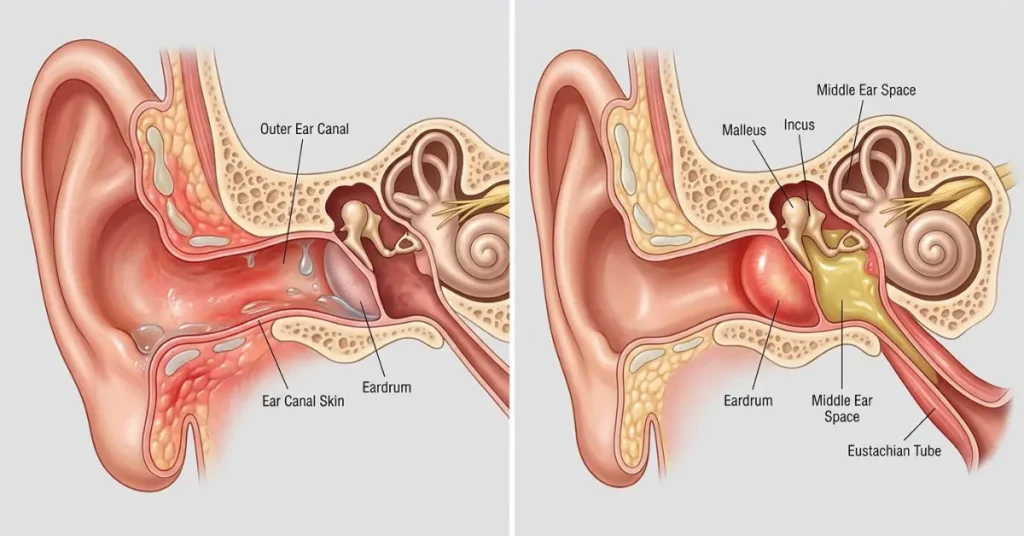
The distinction between these two conditions is not just academic. It completely changes what treatment is needed.
| Swimmer’s Ear (Outer Ear) | Middle Ear Infection | |
|---|---|---|
| Location | Outer ear canal | Behind the eardrum |
| Main Cause | Trapped water and bacteria | Colds, viruses, upper respiratory illness |
| Pain on Tug Test | Yes, gets significantly worse | No change |
| Discharge | Common, drains from canal | Rare unless eardrum perforates |
| Fever | Uncommon unless severe | Common |
| Treatment | Antibiotic ear drops | Oral antibiotics |
| Associated With | Swimming, pool exposure | Recent cold, flu, or blocked nose |
Antibiotic ear drops will not treat a middle ear infection because they cannot reach behind the eardrum. Oral antibiotics will not treat swimmer’s ear because they cannot penetrate the skin of the outer canal at effective levels. A professional paediatric assessment is essential to confirm which condition your child has before any treatment begins.
If your child has recently had recurrent colds or ear infections alongside this episode, our guide on recurrent coughs, colds, and ear infections in Sharjah children explains when a pattern of ear problems needs a specialist review rather than another individual treatment course.
Home Care: What You Can Do Right Now
If your child is in pain and you are waiting to come in, these steps are safe to start immediately.
Keep the ear completely dry. No swimming, no submerging in the bath, until the pain is fully resolved and the treatment course is finished.
Pain management. Paracetamol or ibuprofen at the correct dose for your child’s weight provides meaningful relief while you arrange a clinic visit. Dosing by weight matters in children, so check the chart on the packaging carefully.
Warmth on the outer ear. A warm, not hot, cloth held gently against the outside of the ear can ease discomfort while waiting for the drops to take effect.
Protect during showers. Use a cotton ball lightly coated in petroleum jelly as a water barrier during bathing until the infection has fully cleared.
The Never List:
Never use cotton buds inside the ear. They scratch the canal lining, push bacteria deeper, and are the single most common cause of recurring swimmer’s ear infections we see at ESMC every summer. Never use home remedies such as olive oil, garlic drops, or vinegar solutions. These can feed the infection or cause additional irritation to already inflamed tissue. Never use any ear drops if your child has ear tubes (grommets) without seeing a doctor first. Certain drops can cause serious damage if they pass through tubes into the middle ear.
When to Come to ESMC Today
Swimmer’s ear does not clear on its own. It requires medical-grade antibiotic or antifungal ear drops prescribed after a proper examination. Come to ESMC’s Paediatrics Department without delay if:
- Pain is keeping the child awake at night or they are visibly distressed
- You can see yellow or green discharge from the canal
- There is any fever or visible swelling around the ear, face, or jaw
- Symptoms have not improved after 48 hours of home care
- Your child has ear tubes (grommets). Any ear pain in this group needs same-day assessment
The earlier treatment begins, the faster the recovery. Most children feel meaningfully better within two to three days of starting the correct prescribed drops.
Book a Paediatric Consultation at ESMC Sharjah
What to Expect at Your ESMC Appointment

Our paediatrician Dr. Momina Mahmood uses a lighted instrument called an otoscope to examine the ear canal and confirm whether the infection is in the outer or middle ear. In some cases, we gently clean the canal to remove debris or discharge so that the prescribed drops can reach the canal lining effectively.
Most children are prescribed a course of antibiotic ear drops lasting seven to ten days. Pain typically improves noticeably within two to three days of starting treatment. Finishing the full course is essential even when symptoms resolve early. Stopping drops prematurely is one of the most common reasons we see recurring infections in the same summer season.
UAE-Specific Pool Risks Sharjah Parents Must Know
Hot Outdoor Pools Degrade Chlorine Rapidly
Chlorine breaks down faster at high temperatures. An outdoor pool in Sharjah at 35 degrees Celsius in full summer sun loses its disinfecting effectiveness significantly faster than a cooler pool. If a shared pool is not being tested and topped up daily, bacterial levels can rise to infectious levels even in visibly clear water. The CDC’s guidelines on healthy swimming specifically highlight that warm pool water accelerates the growth of ear-infecting bacteria when disinfectant levels drop. If you are unsure about the maintenance schedule of a shared building or community pool, ask the building management directly before letting your child swim.
Community and Building Pools During Peak Use
Heavy usage during Eid weekends or school holidays can overwhelm the filtration capacity of smaller community pools. Cloudy water, an unusually strong chemical smell, or foam on the surface are all warning signs that the pool is not being adequately maintained. If the water looks off, skip the swim that day without hesitation.
The Cotton Bud Habit
Many families across the UAE routinely use cotton buds to dry children’s ears after the beach or pool. This is the single most common cause of ear canal damage and recurring swimmer’s ear infections we see at ESMC every summer. The ear canal has a natural self-cleaning mechanism. Cotton buds disrupt it, scratch the lining, and compact debris further inward. Replace this habit entirely with the safe drying techniques described in the prevention section below.
Pool Water and Stomach Illness
Shared pools during Eid gatherings also carry a risk of gastrointestinal illness from the same water exposure. If your child develops an upset stomach alongside ear symptoms after pool use, our guide on summer diarrhoea in children in Sharjah explains exactly when that also needs a clinic visit and what to do at home in the meantime.
Post-Swimming Fever
A fever developing within 24 to 48 hours of pool exposure alongside ear pain is a red flag. If your child has also recently had a vaccination and develops a fever, our guide on baby fever after vaccination in Sharjah can help you distinguish between a post-vaccination reaction and an infection requiring treatment.
The Complete Prevention Guide
Before Getting In
Use well-fitting silicone earplugs available at most Sharjah pharmacies. Custom-fitted plugs offer better protection than generic foam ones for children who swim regularly throughout the summer. Apply a thin layer of petroleum jelly around the canal entrance if your child is prone to recurrent infections.
During the Swim
Encourage regular breaks out of the water every 30 to 45 minutes, which gives the ear canal time to begin draining naturally. Discourage prolonged periods fully underwater or vigorous head shaking in the water, both of which drive water deeper into the canal.
After Getting Out: The Tipping Method
Tilt your child’s head to one side with the affected ear facing down, then gently tug the earlobe to open the canal and allow trapped water to run out naturally. Repeat on the other side. Do this every single time after a swim. It takes 20 seconds and prevents the vast majority of infections before they begin.
The Hairdryer Technique
Use a hairdryer on its coolest and lowest setting, held at least 20 centimetres from the ear, directed gently into the canal for 20 to 30 seconds. The gentle airflow evaporates residual moisture that the tipping method does not fully remove. Never use a hot setting. Heat at close range can burn the already sensitive canal lining.
Never Use Cotton Buds
Replace the cotton bud habit permanently with the tipping method and hairdryer technique above. These are safer, more effective, and carry no risk of canal damage or bacterial transfer.
Frequently Asked Questions
How do I know if my child has swimmer’s ear or just water trapped in the ear?
Trapped water without infection causes a muffled, full feeling that usually clears within a few hours on its own using the tipping method. Swimmer’s ear causes persistent or worsening pain, itching inside the canal, discharge, and sensitivity when the earlobe or the tragus bump in front of the ear is touched. The tug test is the fastest home check: if your child flinches or pulls away, it is very likely an infection rather than plain trapped water.
How quickly does swimmer’s ear develop after swimming?
Symptoms typically appear one to two days after the pool exposure that caused them. Early signs are mild itching and a feeling of fullness. By day two to three, pain and redness develop. Without treatment, the infection progresses steadily. It does not resolve on its own, which is why coming to ESMC at the moderate stage rather than waiting is always the right call.
Can swimmer’s ear affect both ears at the same time?
Yes, though it is less common than a single-ear infection. When both ears are affected simultaneously, it is usually linked to heavy or prolonged water exposure such as a full day at a pool. Both ears would typically show the same symptoms and require the same course of antibiotic drops. Always mention both ears to the paediatrician during the consultation so both can be properly examined.
My child has ear tubes (grommets). Is it safe to swim?
Children with grommets can swim in most cases, but any ear pain, discharge, or change in hearing after swimming needs to be assessed the same day at ESMC. Standard over-the-counter or pharmacy ear drops can cause damage if they pass through the tubes into the middle ear space. Do not use any drops at home without a doctor confirming they are safe for a child with grommets in place.
Can swimmer’s ear cause permanent hearing loss?
Mild to moderate swimmer’s ear treated promptly does not cause permanent hearing loss. Temporary muffled hearing is common during an active infection due to swelling of the canal walls, but it resolves fully once the infection clears. Untreated or severely progressed infections that spread beyond the canal can in rare cases cause more serious complications. This is why early treatment at ESMC matters rather than waiting out the symptoms at home.
How long until my child can swim again after swimmer’s ear?
The standard guideline is seven to ten days, the full duration of the treatment course. More importantly, your child should be completely pain-free and the drops course should be finished before returning to the pool. Returning early, even if symptoms have eased, risks reinfection in a canal that has not fully healed. Our paediatric team at ESMC will confirm the specific return date based on how the infection responds.
Is swimmer’s ear contagious?
No. Unlike conjunctivitis or a stomach bug, swimmer’s ear cannot be passed from one child to another through contact. The infection develops from bacteria already present in the child’s own ear canal multiplying in warm trapped water, not from exposure to another infected child. Siblings can safely use the same pool without any risk.
What if my child keeps getting swimmer’s ear every summer?
Recurring swimmer’s ear across multiple summers typically points to consistent contributing factors: cotton bud use, inadequate post-swim drying, a narrower-than-average canal anatomy, or a poorly maintained pool. Bring your child to ESMC’s Paediatrics Department for a full ear canal assessment rather than treating each episode individually. We can identify the underlying pattern and give you a specific prevention protocol tailored to your child. You may also find our guide on recurrent coughs, colds, and ear infections in Sharjah children useful, particularly the section on when recurring ear problems cross the clinical threshold for a specialist referral.
My child is complaining of ear pain but has not been swimming. Could it still be swimmer’s ear?
Swimmer’s ear can occasionally develop without pool exposure. A bath, a shower, or even very high humidity is enough to trap moisture in a susceptible canal. However, ear pain without pool exposure is more commonly a middle ear infection, a dental issue, or jaw-related pain referred to the ear. The tug test is your first check. If pressing the bump in front of the ear worsens the pain, come to ESMC. If it does not, a paediatric assessment will identify the correct cause.
The Bottom Line
Swimming is one of the best ways for children to stay active and cool through a Sharjah summer, and swimmer’s ear should not stop them from enjoying it. Now that you know the signs, the tug test, when to manage at home, and when to come in, you have everything you need to act quickly and with confidence.
If the pain is there, the discharge has started, or your parental instinct says something is not right, Dr. Momina Mahmood and our paediatric team at ESMC are here every day to get your child back in the pool safely.
ESMC Sharjah, Al Zahra Street, Maysaloon. Open 8AM to 11:30PM daily. Walk-ins welcome.